The Best Bedtime Story Apps for Kids in 2026 (We Tested 12)

The best bedtime story app depends on what you need. For AI-personalized stories with 100+ professional voices, Bedtime Stories offers narrated tales starting at $2 with no subscription. For meditation-style sleep stories, Moshi has clinical research backing. For a free library of classic tales, Storyberries is the best option. We tested 12 apps. Here is what each one does, costs, and who it fits best.
$2 per story. No subscription.
Your kid needs a bedtime story. You need five minutes of peace. The app store has 400 options and no useful way to tell them apart.
Here's the problem: bedtime apps have gotten genuinely good, and that's made choosing one genuinely hard. The category used to be "Calm, maybe Headspace, done." Now it includes AI story generators that put your child's name in the plot, reading apps that add sound effects to your voice, voice-cloning tools that let grandma narrate from 2,000 miles away, and physical devices that skip the screen entirely.
We spent time with 12 of them. Not a quick download-and-rate. Actual use, across real bedtime routines, paying attention to what a child actually responds to and what a parent actually has patience for at 8pm.
This post is organized by category, because these apps solve different problems. A parent who wants a "press play and walk away" experience needs a completely different tool than a parent who wants to read aloud with magical sound effects. Find your category, then find your app.
The 2026 Market at a Glance
Before the reviews: a quick look at where this market stands.
The children's audiobook and story app market is valued at approximately $1.79 billion in 2026, projected to reach $4 billion by the mid-2030s at about 9.4% annual growth. The broader audiobook market is even more aggressive, with $35 billion projected by 2030.
What's driving that growth isn't just "more apps." It's a shift in what parents expect from bedtime. Three priorities dominate parent forums and surveys:
- Safety and privacy first. Ad-free, local data processing, no voice recordings stored on external servers. This is non-negotiable for most parents.
- Audio over screens. The research on blue light and melatonin disruption has sunk in. Parents want high-quality audio, not high-intensity visuals, in the 60 minutes before sleep.
- Purposeful content. Not just "a story." A story that teaches something, addresses something, or at least doesn't rot the brain. Parents are choosing apps that embed life lessons, emotional regulation, or educational themes.
These three expectations define every category below.
Category 1: Sleep and Mindfulness Platforms
These apps aren't story generators. They're sleep environments. The goal is to calm the child down, provide ambient narrative, and get them to drift off. The story is the vehicle, not the destination.
Moshi
Moshi has been in the bedtime game longer than most, and it shows. Over 1,000 hours of original content: sleep stories, meditations, white noise, music. All built around proprietary "Moshling" characters that younger kids genuinely bond with.
The headline stat: a New York University study found that children using Moshi fell asleep 28 minutes faster and slept 22 minutes longer. That's peer-reviewed data, not marketing copy. The 2026 version includes celebrity narrations (Goldie Hawn, Patrick Stewart) and a "Play" section with puzzles and memory games for daytime use.
Pricing: $12.99/month or $79.99/year. Promotional rates as low as $49.99 during seasonal sales.
Best for: Children ages 2 to 8 with anxiety or bedtime resistance. Parents who want scientifically validated sleep improvement.
Watch out for: Some parents on Reddit report difficulty navigating refund policies through app stores. The subscription is one of the pricier options in the category.
Calm Kids
Calm expanded into the kids' space by leveraging what it already does best: premium narration and massive content libraries. The Calm Kids section now includes content from Peppa Pig, Kung Fu Panda, Minions, Thomas and Friends, and Trolls. Celebrity Sleep Stories feature Harry Styles, Matthew McConaughey, Idris Elba, and Diane Keaton.
The strategic advantage is that parents who already use Calm for their own meditation get the kids' content included. One subscription, two use cases.
Pricing: $79.99/year or $16.99/month. Family plan (up to 6 accounts): $203.88/year, roughly $34 per person annually.
Best for: Families where a parent already uses (or wants to use) Calm for themselves. The IP partnerships make it especially appealing for kids who are fans of specific characters.
Watch out for: The family plan price looks high upfront. Some parents feel the kids' content is an add-on rather than a core focus.
Category 2: Interactive Reading Aids
These apps don't replace the parent. They augment the parent. The philosophy is that the storytelling relationship between adult and child is the point, and technology should enhance it, not substitute for it.
Readmio
Readmio is the most philosophically distinctive app on this list. It removes illustrations entirely. The child doesn't look at a screen. Instead, the parent reads aloud from the phone, and Readmio's on-device voice recognition triggers atmospheric sound effects (rustling leaves, distant thunder, gentle music) when the parent reaches specific passages.
The result feels like a private theater production powered by a parent's voice. The library is strong: 500+ stories including Aesop's fables, science tales, and ecology adventures, all developed with child psychologists. Recent updates added dyslexia-friendly display options.
And the privacy is airtight. All voice recognition runs locally on the device. No recordings are transmitted. No cloud processing. Nothing stored.
Pricing: Free Explorer Set. $49.99/year, $12.99/month, or $159 to $199 for lifetime access.
Best for: Parents who want to be the storyteller. Screen-free families. Privacy-conscious households. The lifetime pricing makes it one of the cheapest long-term options.
Watch out for: Requires the parent to be present and read aloud every time. Doesn't work for the exhausted-parent-needs-a-break scenario. No personalization with the child's name.
Storybook
Storybook occupies a unique niche: it combines bedtime stories with guided infant and toddler massage techniques. Over 400 content tracks and 100+ massage techniques designed by certified sleep experts. Recommended by the Family Sleep Institute and Infant Massage USA.
The idea is that physical touch and narrative combine for deeper relaxation and bonding. Internal data claims 92% of users report improved bedtime routines and 96% feel more connected to their children.
Pricing: $59.99/year. Promotional gift plans available ($9.99 for 3 months, $39.99/year limited-time).
Best for: Parents of infants and toddlers (0 to 4) who want to incorporate physical bonding into the bedtime routine. The massage guidance is genuinely differentiating.
Watch out for: Less relevant for older children. The massage component may feel gimmicky to parents who just want a story.
Category 3: AI Story Generators
This is the fastest-growing category in bedtime apps. Large language models now generate personalized stories where the child is the hero, their pet is a sidekick, and the moral is whatever the parent chooses. The quality has improved dramatically, but the category is still young enough that differences between tools are significant.
We did a deep-dive comparison of AI story generators in a separate post. Here's the higher-level view.
Oscar Stories
Places your child inside classic literary worlds: Alice in Wonderland, The Jungle Book, Grimm's Fairy Tales. Developed with educators. Warm illustrations, soothing narration, and embedded moral selection. The "classic worlds" angle is unique and clever.
Pricing: $4.99/month or $39.99/year. Coin packs available.
Best for: Families who value literary heritage and want their child woven into classic tales.
Bedtimestory.ai
The deepest personalizer. Include family members as characters, select art styles (watercolor, 3D render), embed specific morals. The "Magic Editor" lets you refine after generation. Also offers adventure and math stories.
Pricing: Free tier available. Alpha Pro: $8.25/month.
Best for: Parents who want granular control over story content: specific morals, characters, themes.
Bedtime Stories (bedtime-stories.fun)
Full disclosure: this is our product.
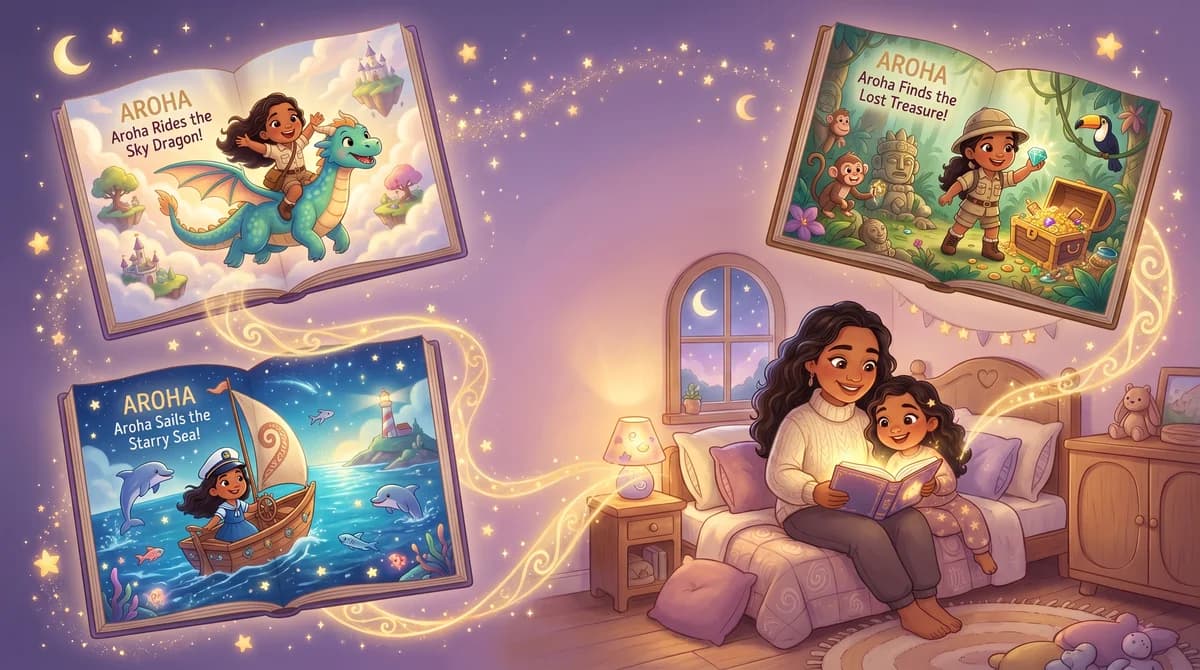
100+ professional voices powered by ElevenLabs, plus custom voice upload (7 languages) so you can narrate stories in your own voice. Not robotic TTS. Full Cast mode gives up to 6 characters their own distinct voice. The child is the protagonist of every story, with siblings, friends, and pets as supporting characters. Every story includes cover art, read-along text, and downloadable audio. The research behind why bedtime stories matter is baked into how we design story structure and vocabulary.
No subscription. Pay per story: $2 for one, $8 for five, $15 for ten.
Pricing: $2 to $15 per use. No recurring fees.
Best for: Parents who want premium audio quality and hate subscriptions. Families who want a private audiobook experience their child can replay without a screen.
What we don't do: No interactive branching, no voice cloning, no dedicated mobile app (web-based with downloadable audio).
For a detailed comparison of all AI generators including Perchance, Sleepytale, Scarlett Panda, and Talefy, see our full AI generator comparison.
Personalized & parent-voice apps
A distinct group of apps makes your child the hero and lets you narrate in your own voice. Little Stories is the benchmark: a large catalog of human-written, illustrated personalized books with parent-voice recording and 10+ languages, on a subscription. Fable puts your child in the story too, with print-on-demand books (subscription, English only). And Bedtime Stories generates brand-new personalized bedtime stories for any theme you choose, narrated in your own recorded voice or 100+ professional voices, for $2 per story with no subscription.
These solve a different job than sleep apps or audio libraries. For a full breakdown, see our honest comparison of personalized bedtime story apps and Bedtime Stories vs Little Stories.
Category 4: Screen-Free Hardware
Some parents have decided the answer isn't a better app. It's no app at all. The screen-free hardware category has matured significantly, with two dominant players in 2026. They're genuinely great products. But the long-term cost catches many families off guard.
Toniebox
A soft, padded, Wi-Fi-enabled speaker that plays audio when a child places a hand-painted figurine ("Tonie") on top. No screen, no buttons beyond volume and skip (tilt the box). Content includes Disney, Sesame Street, Peppa Pig, and hundreds of audiobooks and songs.
The tactile, toy-like design is magnetic for children ages 1 to 5. Kids can operate it independently: pick a Tonie, place it on the box, listen. The offline mode means it works anywhere.
Pricing: Toniebox 2 starter set: $129.99. Individual Tonies: $19.99 each. A Creative Tonie, which holds 90 minutes of your own recordings, is $9.99 (verified August 2026).
Best for: Young children (1 to 5) who need a completely independent, screen-free audio experience. Parents who want to remove devices from the bedroom entirely.
Watch out for: The Tonie collection gets expensive fast. Each figurine is $19.99, and kids burn through them. A family with 20 Tonies has spent about $400 on content alone, on top of the $129.99 starter set. Physical storage becomes an issue. And kids tend to outgrow it by age 6, leaving you with a shelf of expensive figurines.
If the figurine bill is what is pushing you to look elsewhere, we compared the devices that replace it, and the routes that skip the hardware entirely, in our guide to Toniebox alternatives.
Yoto Player
A more gadget-like audio player controlled by physical cards. Plays audiobooks, podcasts, music, and radio. Includes a nightlight, clock, and room thermometer. Content library includes Roald Dahl, Disney, and a free daily podcast.
The Yoto Player feels like a "grown-up device" compared to the Toniebox, which is part of its appeal for kids 4 to 12. The cards are compact (100 cards fit in a small book), and the Yoto Club subscription ($9.99/month for 2 credits) provides ongoing content.
Pricing: Yoto Player (3rd Generation): $109.99. Yoto Mini: $79.99. Cards: $9.99 to $39.99. Yoto Club: from $4.99/month (verified August 2026).
Best for: Kids ages 4 to 12 who want something that feels like "their device." Families who want audiobooks, podcasts, and music in one screen-free player.
Watch out for: The initial device cost plus cards adds up. The Yoto Club subscription (from $4.99/month) helps with ongoing content but is yet another recurring charge.
The Cost Reality: Hardware vs. Apps
Here's what most comparison posts won't show you. The actual cost of bedtime stories over time:
| Toniebox | Yoto Player | Moshi (App) | Bedtime Stories (App) | |
|---|---|---|---|---|
| Upfront cost | $129.99 (starter set) | $109.99 ($79.99 Mini) | $0 | $0 |
| 10 stories | $200 (10 Tonies) | $100 (10 cards) | $80/yr (all content) | $15 |
| 50 stories over 2 years | $1,130 | $610 | $160 | $75 |
| New story tonight? | Drive to store or wait for shipping | Order a card online | Browse library | Generate in 2 minutes |
| Personalized with child’s name | No | No | No | Yes |
| Screen required | No | No | Yes (to browse) | Only to create (audio plays offline) |
A single Tonie figurine costs $19.99. For less than that, a family can get 10 personalized audio stories, each one starring their child, with professional voices, downloadable for offline listening on any speaker or device.
That doesn't mean hardware is wrong. Toniebox and Yoto solve a real problem: they give a child complete independence. A 3-year-old can pick a Tonie and start a story without any adult help. That's worth something. But for families watching the budget, or families who want new stories regularly without buying another physical object, app-based audio is a fraction of the cost.
Some families use both: hardware for independent play during the day, an app for fresh personalized stories at bedtime.
The Specialists
Not every family fits neatly into the four categories above. A few smaller apps serve specific needs worth knowing about.
Snoozly. Pure simplicity. Baby sleep sounds and a night light. No stories, no content library, no AI. Just white noise, lullabies, and a warm screen glow. Ad-free even on the free tier. Perfect for infants or parents who want the absolute minimum before sleep. Pricing: roughly $2/month or $15/year.
SleepyVoice. Voice cloning for bedtime. Uses AI to clone a parent's voice and narrate stories in it. A deployed parent, a traveling professional, or a grandparent who lives far away can still "read" a bedtime story. We explored this use case in depth in our post about long-distance bedtime stories. Pricing: $4.99/month for annual Pro plan.
CalmTales. Designed specifically for neurodivergent children, including those on the autism spectrum. Includes echolalia integration and sensory-aware story design. A premium option for families with specific needs that mainstream apps don't address. Pricing: subscription-based.
Side-by-Side Comparison
| App Name | Best For | AI Personalized? | Voice Narration | Pricing | Age Range | No Subscription? |
|---|---|---|---|---|---|---|
| Bedtime Stories | Premium audio, no subscription | Yes | 100+ professional voices + custom voice upload (7 languages) | $2/story (no subscription) | 3-12 | Yes |
| Moshi | Sleep meditation | No | Celebrity narrators | $13/month | 2-10 | No |
| Calm Kids | Meditation + sleep | No | Meditation voices | $15/month | All ages | No |
| Storyberries | Free classic library | No | Parent reads | Free | 2-8 | Yes |
| Fable | AI stories with photos | Yes | AI voices | Subscription | 2-12 | No |
| Oscar Stories | AI + classic tales | Yes | Basic TTS | Subscription | 3-12 | No |
| Toniebox / Yoto | Screen-free hardware | No | Pre-recorded | $79.99+ device | 3-8 | Yes |
Want to try the one we built?
Your child as the hero. 100+ voices. Full-cast narration. $2 per story, no subscription.
Create a Story in About 2 MinutesHow to Choose (Without Overthinking It)
There's no "best bedtime app." There's the one that fits how your family actually does bedtime. Here's the shortcut:
"I just need my kid to fall asleep." Start with Moshi (proven sleep science) or Calm (especially if you'll use it too). If you want screen-free, look at Toniebox for younger kids or Yoto for older ones.
"I want to read to my child, but better." Readmio turns your voice into a theater experience. Storybook adds guided massage for babies and toddlers.
"I want my child to be the hero of the story." AI generators: Oscar Stories for classic worlds, Bedtimestory.ai for deep customization, Bedtime Stories for full-cast audio with professional voices.
"I'm not there at bedtime." SleepyVoice clones your voice so your child hears you even when you're traveling. Downloadable audio from Bedtime Stories works offline without a parent present.
"My child has specific needs." CalmTales for neurodivergent children. Moshi for anxiety (NYU-validated). Storybook for tactile/sensory bonding.
"I refuse to pay another subscription." Bedtime Stories (pay per story, no recurring fees), Readmio lifetime ($159 to $199, one-time), or Toniebox/Yoto (buy the device and cards, done).
If your child is between 3 and 5 years old or 5 and 8 years old, we have age-specific guides that can help you narrow down what works for their developmental stage.
A Note on Safety and Privacy
Two things dominate parent conversations about bedtime apps in 2026: data privacy and subscription pricing.
On privacy: The range is wide. Readmio processes everything locally. Nothing leaves the device. Toniebox and Yoto are offline-capable hardware. Most app-based platforms use cloud processing, which means some data is transmitted. The questions to ask any platform: Does it store voice recordings? Is it COPPA-compliant? Is the content ad-free?
On subscriptions: This is the number one complaint on parent forums. "I don't mind paying. I mind forgetting to cancel." Several options exist for subscription-averse parents: Bedtime Stories (pay per story), Readmio (lifetime access), and hardware devices (buy once). If you do subscribe, set a calendar reminder before the trial ends. Multiple parents on Reddit report unexpected renewals from Moshi and Storybook due to tight cancellation windows.
For a full guide on AI safety, content filtering, and what to look for in any children's app, read: Are AI Bedtime Stories Safe for Kids?
Frequently Asked Questions
What is the best free bedtime story app?
Moshi and Calm both offer free tiers with limited content. Bedtimestory.ai has a free tier for AI-generated stories. Readmio’s Explorer Set is free with a handful of stories. None of these free tiers are unlimited, but they’re enough to test whether the format works for your family.
Are bedtime story apps safe for toddlers?
The apps reviewed here are designed for children, with age-appropriate language and no ads. Moshi and Storybook are specifically validated for ages 2 and up. For AI-generated content, safety measures vary by platform. Always listen to the first few stories yourself before letting a toddler listen unsupervised.
Is a bedtime story app better than reading to my child?
Different, not better. Reading aloud builds a bonding experience that no app can replicate. Apps like Readmio actually enhance parent-led reading. Other apps (Moshi, Bedtime Stories, Toniebox) are useful when a parent is unavailable, exhausted, or wants variety beyond what they can improvise.
Do bedtime story apps actually help kids fall asleep?
Moshi is the only app with a peer-reviewed NYU study showing faster sleep onset (28 minutes) and longer sleep duration (22 minutes). Most other apps rely on calming audio and routine-building, which pediatric sleep research generally supports. The key factor is consistency: any calm, screen-free audio routine helps signal the brain that it’s time to sleep.
What is the cheapest way to get bedtime stories for my child?
Your local library card (free audiobook apps like Libby). For personalized stories, Bedtime Stories at $2/story is the lowest per-story cost. Readmio’s lifetime access ($159–$199) is the cheapest long-term subscription alternative. Free AI generators like Perchance exist but lack audio quality. Compare all options with our bedtime cost calculator at bedtime-stories.fun/tools/bedtime-cost-calculator.
Related Reading
- Best AI Bedtime Story Generators for Kids in 2026 Deep dive on 8 AI-powered generators with head-to-head comparisons.
- Perchance AI Bedtime Story Generator: An Honest Hands-On Review What the popular free generator actually delivers, tested July 2026.
- AI Bedtime Stories: Are They Safe for Kids? Safety, data privacy, and content filtering for AI story tools.
- What Screens Do to Your Child's Brain Before Bed The case for audio over screens at bedtime.
- Why Bedtime Stories Matter More Than You Think The developmental science behind reading to your child.