Yoto vs Toniebox 2026: The True Cost, and Is Either Worth It?

The Yoto Player is $109.99 plus $9.99 per card; a Toniebox 2 starter set is $129.99 plus $19.99 per figurine. Over three years the Yoto runs about $470 versus $850 for a Toniebox, roughly 45% less. Both deliver screen-free audio, but cheaper alternatives like AI story apps and library audiobooks offer the same bedtime experience at a fraction of the cost.
$2 per story. No subscription.
Your kid played with a Toniebox at a playdate and now it's all they talk about. Or you saw the Yoto Player on a "best gifts for toddlers" list and it looks perfect: a screen-free audio player that lets your child listen to stories independently. What's not to love?
Then you looked at the price. The Toniebox 2 starter set is $129.99. Each figurine is $19.99. The Yoto Player is $109.99, plus cards from $9.99 each. And your kid is going to want more than one. (Prices verified July 2026.)
We did the math. Over two years, a Toniebox with a modest collection costs $610-$850. A Yoto Player runs $350-$470. And there are alternatives that deliver the same screen-free audio experience for under $100 total.
This post breaks down the real numbers, compares the two leading devices, and covers every option from DIY hacks to AI-powered alternatives. So you can make the decision that fits your family's budget and your kid's bedtime.
The Two Leading Devices
Both are genuinely excellent products. Parents who own them mostly love them. Here's what you're actually getting with each.
Toniebox 2 ($129.99 starter set)
A soft, padded cube operated by squeezing ears (volume) and tapping sides (skip). Place a hand-painted figurine on top and audio plays. No menu, no screen, no navigation. A 16-month-old can figure it out. The 2025 update added a Dynamic Light Ring for interactive games, and content includes Disney, Sesame Street, Peppa Pig, and Ms. Rachel.
The good: Toddlers operate it independently from day one. Figurines double as toys. The "put the figure on the box" ritual becomes part of bedtime. No ads, no algorithms.
The catch: Each figurine is $19.99 and kids burn through them fast. Content is fixed per figurine (no swapping). Storage becomes a problem after 20+ figurines. Kids typically age out by 5-6.
Yoto Player 3rd Generation ($109.99) and Yoto Mini ($79.99)
Instead of figurines, Yoto uses NFC cards that slot into the top. The current Player is the 3rd Generation. The device includes a nightlight, room thermometer, and "Okay-to-Wake" clock. It's designed to grow with your child: toddler stories at 2, chapter books at 6, Harry Potter at 8, podcasts at 10.
The good: Battery life up to 24 hours. Content ranges from toddler to young teen. Cards are compact (100 fit in a binder). "Make Your Own" cards let you load free content like Librivox and Storynory.
The catch: Cards lack the "toy factor" of figurines. The Yoto Club subscription adds ongoing cost. Less "magical" bedtime ritual than placing a character on a box.
Is the Yoto Player Worth It?
The Yoto Player is worth it if you want one screen-free device that grows with your child from about age 2 into the early teens. At $109.99 the 3rd Generation Player costs less upfront than a Toniebox 2 starter set ($129.99), its cards are cheaper ($9.99 versus $19.99 on average), and it holds its usefulness for years instead of being aged out by 5 or 6. Over three years it runs about $470 against $850 for a Toniebox, roughly 45% less (full breakdown below).
Where it earns the price: up to 24 hours of battery, content that spans toddler stories to Harry Potter to podcasts, a nightlight and Okay-to-Wake clock built in, and "Make Your Own" cards that load free audio from Librivox or Storynory. The Explorer tier of Yoto Club ($4.99/month) streams 200+ Yoto Originals, which is the cheapest way to keep a Yoto fed without buying a card a month.
Where it falls short: the cards lack the toy factor of a Toniebox figurine, so the "place the character on the box" bedtime ritual is missing. For a child under 3 who needs to run the device completely on their own, the Toniebox is still easier. And like any dedicated player, you are paying $80 to $110 for hardware before a single story plays.
That last point is the one worth sitting with. The Yoto's real job is screen-free audio your child chooses independently. If what you actually want is a personalized bedtime story in a voice your child loves, you can get that from a phone and a Bluetooth speaker for a fraction of the hardware cost. We cover those app and AI alternatives further down.
The Real Cost: Year by Year
Here's what most reviews won't show you: the cost of owning these devices over time. The starter set is just the beginning. Content is where the money goes.
Assumptions: One new Tonie ($19.99) or Yoto card ($9.99) per month. Starter set includes device plus one content piece; we use the $129.99 Toniebox 2 starter set. No subscriptions, no bundles, no sales. Just regular retail pricing, verified August 2026.
| Toniebox 2 | Yoto Player | Yoto Mini | |
|---|---|---|---|
| Starter set | $129.99 | $109.99 | $79.99 |
| Year 1 total | $370 | $230 | $200 |
| Year 2 total | $610 | $350 | $320 |
| Year 3 total | $850 | $470 | $440 |
| Content pieces | 37 figurines | 37 cards | 37 cards |
By Year 3, the Toniebox has cost about 80% more than the Yoto Player ($850 vs $470). And that's with just one piece of content per month. Families who buy 2-3 Tonies per month (common during the first year of excitement) can easily cross $1,000 by Year 2.
But a few things change the math:
The Yoto Club. The overhauled Yoto Club now offers three tiers: Explorer ($4.99/mo) for unlimited streaming of 200+ Yoto Originals, Collector ($9.99/mo) adding 1 free card, and Collector+ ($16.99/mo) adding 2 cards. The Explorer tier is the budget hack. For $60/year, you get massive content access without buying physical cards.
The Toniebox bundle deals. Tonies offers 10-20% discounts through bundle subscriptions and free shipping over $45. Black Friday typically brings 30% off the starter set (as low as $99). Timing your purchase matters.
The gift factor. Grandparents, aunts, and uncles buy Tonies as gifts. If your family is the type where relatives bring a figurine to every birthday and holiday, your actual out-of-pocket for content drops significantly.
The resale factor. Tonies hold remarkable resale value. Individual figurines sell for $12-$16 on eBay (60-80% of retail). A curated Toniebox collection can recover $80-$100 for the device and 50-70% for the figurines. This makes Toniebox less of a sunk cost and more of a depreciating asset with real liquidation value. Yoto cards, being easier to damage, retain less (45-60%).
When Hardware IS Worth It
For some families, the hardware is absolutely worth the money. Here's when:
Your child is under 3. A toddler can't navigate an app, ask for a story, or operate a phone. They CAN pick up a figurine and put it on a box. That independence ("my child plays a story without me") is worth real money to a parent of an 18-month-old.
You're fighting screen time battles. If your family is reducing tablet and phone use, a physical audio device is a tangible replacement. The child has "their thing" that isn't a screen. The behavioral shift is the product, not the device. Research on screen time vs audio stories supports this approach.
Your kid has a long attention span for audio. Some children listen to the same Tonie 50 times and love it. If your child is a natural audio listener, the per-play cost of a $20 figurine drops to pennies.
Your extended family will buy content. If grandparents and relatives regularly gift Tonies or Yoto cards, your content library grows without you paying for most of it.
You're a "buy once, buy right" family. The Yoto Player, specifically, can realistically last from age 3 to age 10+. If you see it as a 7-year investment, the annual cost of the device itself is under $16/year.
When It Isn't: The Case for Alternatives
For other families, the math doesn't work. Here's when the hardware isn't worth it:
Your child gets bored fast. If your kid listens to a new Tonie twice and moves on, you're paying about $10 per listen. That's more expensive than a movie ticket.
You're on a tight budget. $140 upfront plus $200/year in content is a significant line item in a family budget. There's no shame in that. And there are alternatives that cost a fraction. Our bedtime cost calculator compares all of them side by side.
You only need it for bedtime. Toniebox and Yoto are "all-day" devices: car rides, play time, quiet time, bedtime. If your primary need is a bedtime story, you're buying a Swiss Army knife when you need a spoon.
Your child is 4+ and you're starting from scratch. At this age, the Toniebox's tactile advantage is less important. The child can follow a story from an app, and the "toy factor" of figurines matters less.
You want personalized content. Neither Toniebox nor Yoto can put your child's name in a story or generate a new adventure every night. The content is fixed, professional, and high-quality, but it's the same for every child who buys that figurine.
The good news: "screen-free audio at bedtime" doesn't require a $100 device. It requires audio and a speaker.
Looking for a screen-free bedtime story without the hardware cost?
Try a free personalized story where your child is the hero, narrated by one of 100+ professional voices. No device needed. Just a speaker and about 2 minutes.
The Alternatives: Screen-Free Audio Without the Hardware Price
This section covers the software routes. If you want the other boxes compared instead, with prices, WiFi requirements and which ones accept your own recordings, see our roundup of 7 Toniebox alternatives.
The key insight is that "screen-free for the child" doesn't mean "no phone involved." A parent can create or select a story on their phone, hit play, connect to a $20 Bluetooth speaker in the kid's room, and put the phone in their pocket. The child hears exactly what they'd hear from a Toniebox: a story, through a speaker, with no screen in sight.
AI Story Generators: Fresh Content Every Night
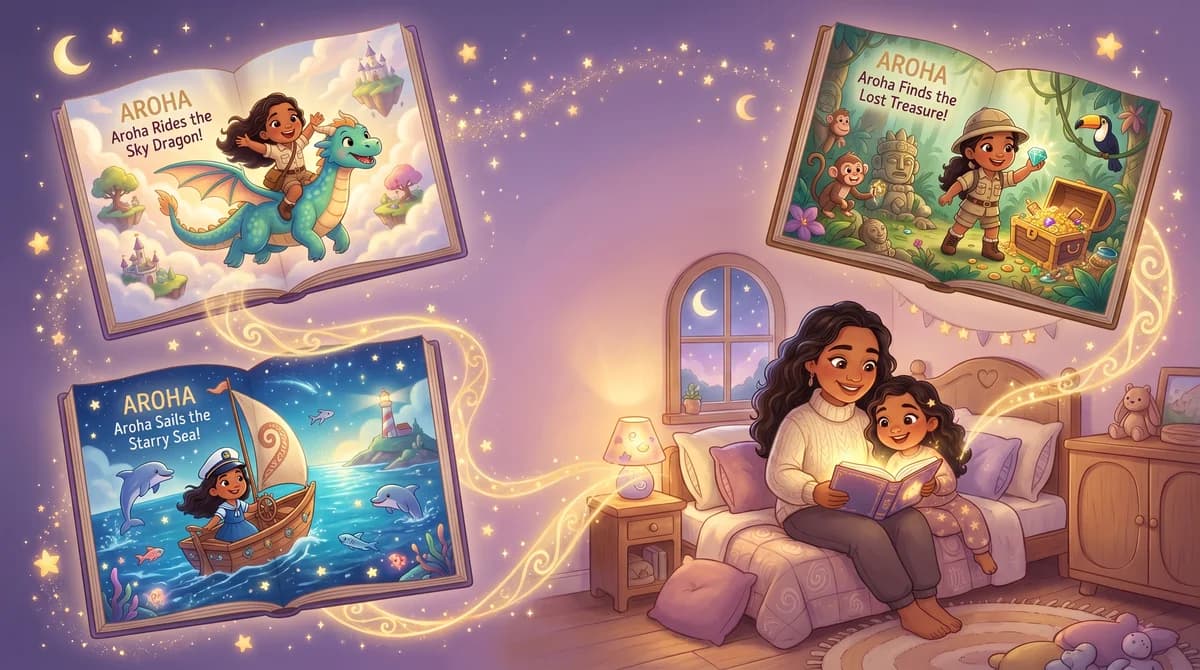
This is the fastest-growing category, and the one thing hardware can't do: generate a fresh story starring your child, by name, every single night. No buying another figurine. No replaying the same 20 stories. Every bedtime is a new adventure tailored to your child's age, interests, and even the life lesson you choose.
Bedtime Stories (our product, full disclosure) generates personalized stories with 100+ professional voices and Full Cast mode (up to 6 character voices), plus custom voice upload (7 languages) so you can narrate in your own voice. Your child is the hero. No subscription. $2 per story, $8 for 5, $15 for 10. Every story includes downloadable audio that plays on any speaker without a screen.
Other options in this space include Oscar Stories and Bedtimestory.ai. For a deeper look, see our AI bedtime story generator comparison.
Moshi: The Sleep Specialist
Moshi focuses specifically on sleep: not just stories, but meditations, white noise, and relaxation tracks designed by sleep experts. An NYU study found children fall asleep 28 minutes faster with Moshi. $49.99/year for the full library. Play it through any speaker.
Best for: Kids who struggle to fall asleep. Audio is designed for wind-down, not stimulation.
Readmio: The Parent-Involved Option
Readmio turns your phone into a sound-effects engine. The parent reads aloud, and the app triggers atmospheric sounds at the right moments. 500+ stories, offline processing, lifetime subscription for $59.99.
Best for: Parents who want to read aloud themselves. Screen-free by design. One-time cost.
The Full Comparison
| Toniebox (2yr) | Yoto (2yr) | Bedtime Stories (2yr) | Moshi (2yr) | Readmio | |
|---|---|---|---|---|---|
| Total cost | $610 | $350 | $234 | $100 | $60 |
| Stories available | 25 (fixed) | 25 (fixed) | 312 (unique, personalized) | 400+ (fixed) | 500+ (fixed) |
| Child is protagonist | No | No | Yes | No | No |
| Fresh content | No | MYO (limited) | Yes (on demand) | No | No |
| Screen-free | Yes (device) | Yes (device) | Yes (downloadable audio) | Yes (speaker) | Yes (parent reads) |
The DIY Hack: Free Content on Any Speaker
If you want screen-free audio stories tonight and you have $0 to spend, here's what works:
Librivox. Free public domain audiobooks read by volunteers. Thousands of children's titles. Download MP3s to any device. Quality varies, but the classics (Peter Pan, Wizard of Oz, Alice in Wonderland) have multiple recordings.
Storynory. Free podcast with original and classic stories, specifically for children. New episodes weekly. High production quality. Works on any podcast app.
Lit2Go. Free audiobooks from the Florida Educational Technology Clearinghouse. Organized by grade level. Includes the text alongside the audio.
Your local library app (Libby/OverDrive). Free audiobooks including children's titles. Download for offline listening. Works through a phone connected to a speaker.
The "Yoto MYO hack" works the same way on any device: download free content, play it through a $20 Bluetooth speaker, done. The Yoto just makes the interface child-friendly, which matters for independent play, but less for bedtime when a parent is controlling the audio anyway.
How to Choose: A Decision Framework
"Do I mainly need bedtime stories?"
Skip the hardware. Bedtime Stories ($2/story) gives you personalized stories with 100+ voices and no subscription. Moshi ($49.99/year) for press-play sleep audio. Readmio ($59.99 lifetime) if you want to read aloud yourself.
"Is my child under 3 and do I need them to use it independently?"
Toniebox 2. Nothing else matches the tactile simplicity for toddlers. Budget $350 for the first year (device + ~12 Tonies). Buy during Black Friday if you can.
"Is my child 3-8 and do I want a device that grows with them?"
Yoto Mini ($79.99). Use the Explorer subscription ($4.99/mo) for streaming content. Budget ~$140 for the first year.
"Do I have $0 and a phone?"
Librivox + Storynory + a speaker you already own. Free. Tonight.
A Word About Screen Time and the AAP
The American Academy of Pediatrics updated its digital media guidelines in early 2026, and the shift is important. The new focus isn't "hours per day" but "context and quality." The AAP explicitly warns against "engagement-based designs" (infinite scrolling, autoplay, algorithmic feeds) while praising "child-centered designs" that promote agency.
An audio player satisfies this framework perfectly: finite content, no algorithm, the child decides when to start and stop. But here's the part most reviews miss: the AAP doesn't distinguish between audio from a dedicated device and audio from a phone used as a speaker. A phone playing a downloaded story through a Bluetooth speaker, with the screen off and the phone in another room, delivers the identical developmental experience as a Toniebox.
The difference is in the interaction model. A Toniebox lets a toddler independently choose and play content. That's genuine agency. A phone-to-speaker setup requires a parent to queue the audio. For bedtime, when a parent is already present for the tuck-in ritual, this distinction is irrelevant. For independent daytime play, it matters.
Bottom line: if your concern is screen exposure, both hardware devices and audio apps are pediatrician-approved. The research supports audio-first content for bedtime regardless of the source device.
Frequently Asked Questions
Is Toniebox worth it in 2026?
It depends on your child’s age and your family’s budget. For toddlers under 3 who need independent, screen-free play, the Toniebox is hard to beat. For families primarily looking for bedtime stories, app-based alternatives like Moshi, Readmio, or AI story generators deliver the same screen-free audio experience at a fraction of the cost.
How much does a Toniebox cost over 2 years?
The Toniebox 2 starter set is $129.99 (verified August 2026). With one new figurine per month ($19.99 each), the 2-year total is approximately $610. Families who buy 2-3 Tonies per month can easily exceed $1,000 by Year 2.
Is Yoto Player better than Toniebox?
Neither is objectively better. Toniebox wins for toddlers under 3 thanks to its tactile simplicity. Yoto wins for longevity (content spans ages 2-14+), battery life (up to 24 hours), and lower ongoing cost. The Yoto Mini at $79.99 with the Explorer subscription ($4.99/month) is the most budget-friendly hardware option.
Is the Yoto Player worth it in 2026?
For families who want one device that lasts from toddler to tween, yes. At $109.99 (3rd Generation) the Yoto Player costs less upfront than a Toniebox 2 starter set ($129.99), its cards are cheaper ($9.99 vs $19.99), and content spans ages 2 to 14+, so you are not re-buying hardware as your child grows. Over three years it runs about $470 versus $850 for a Toniebox, roughly 45% less. It is worth it if you value longevity and battery life; if your child is under 3 and needs to operate it alone, the Toniebox is the better fit.
What is a cheaper alternative to Toniebox?
The Yoto Mini ($79.99) is the most affordable dedicated device. App alternatives include Readmio ($59.99 lifetime), Moshi ($49.99/year for sleep-focused audio), and AI story generators like Bedtime Stories ($2/story with personalized content and professional voices). Free options include Librivox, Storynory, and your local library’s Libby app.
Can I use a phone instead of a Toniebox for bedtime stories?
Yes. The American Academy of Pediatrics’ 2026 guidelines don’t distinguish between audio from a dedicated device and a phone used as a speaker. A phone playing a downloaded story through a Bluetooth speaker with the screen off delivers the same developmental experience. The difference is that a Toniebox allows toddler-independent operation, which matters more for daytime play than bedtime.
Related Reading
- Best Bedtime Story Apps for Kids in 2026 — comprehensive app roundup with pricing
- Best AI Bedtime Story Generators for Kids (2026) — deep-dive on AI story tools
- Screen Time vs Audio Stories: Why Audio-First Matters — the science behind audio over screens
- Why Bedtime Stories Matter — developmental research
- Narrator vs Full-Cast Voices — understanding voice options for audio stories