Bedtime Fairy Tales: Why the Originals Aren’t Great for Bedtime (And What to Tell Instead)

Classic fairy tales like Cinderella and Little Red Riding Hood were never written for children. But the psychological structure behind them (good vs evil, the dark forest, the hero’s journey) is extraordinarily well-designed for child development. Here are 8 reimagined fairy tale themes that keep the 2,000-year-old architecture while updating the values for modern kids.
$2 per story. No subscription.
Here's something worth sitting with: the story of Cinderella is at least 2,000 years old. Variations have been found in ancient Egypt, medieval China, and Indigenous North America, all independently, across cultures that never contacted each other.
Why would the same story keep appearing?
Because Cinderella isn't about a glass slipper. It's about a child who is mistreated, overlooked, and powerless, and who, through patience and inner worth, is seen for who they truly are. That's not a European story. That's a human story. And children recognize it instinctively because they live some version of it every day: in the classroom, in the playground, in the family.
Developmental psychologists call this "narrative transport." When a child hears a bedtime fairy tale, they don't just follow the plot. They inhabit it. They project their own fears onto the villain, their own hopes onto the hero, and their own anxieties onto the dark forest. The story becomes a safe laboratory for emotions that are too big to face directly.
This is why fairy tales matter. The problem is that the most popular versions come with significant baggage.
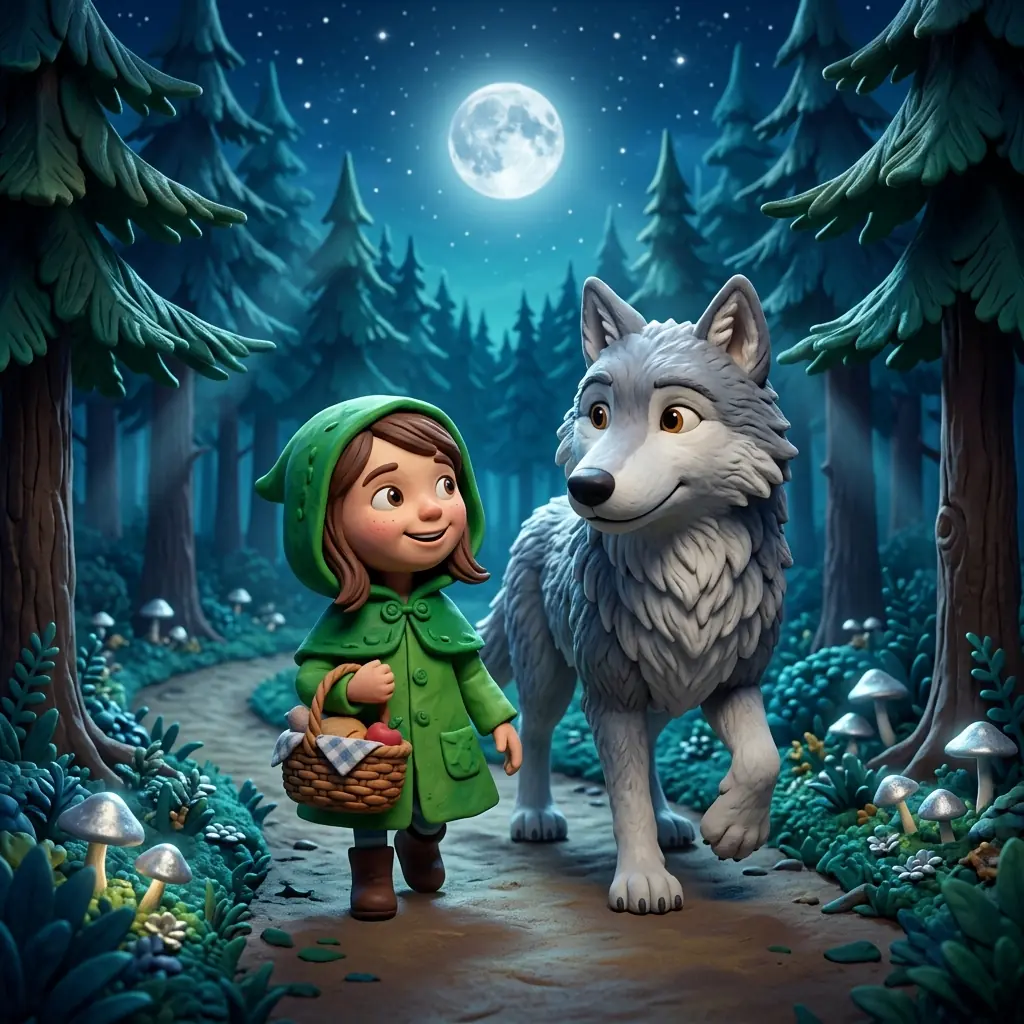
Here's what a reimagined fairy tale sounds like in practice — same dark-forest architecture, modern values, calm ending. Made with Bedtime Stories:
 Ages 5-6
The Wolf Who Walked Home
In a moonlit forest, brave Sam in her green cloak finds a lost, gentle wolf with a thorn in his paw — a Red Riding Hood reimagined for a calm bedtime.

8 Reimagined Fairy Tale Themes for Tonight
Each of these themes reimagines a classic fairy tale structure for modern kids. They keep the psychological architecture (the hero's journey, the dark forest, the transformation) while updating the values. Use them as bedtime stories, starting points for your own versions, or as prompts in Bedtime Stories to get a fully personalized, narrated fairy tale starring your child.
- The Inventor Princess. Your child is a princess (or prince) whose kingdom has a problem: the river has dried up, the birds have stopped singing, the stars have gone dim. Instead of waiting for rescue, they build something. A windmill. A bridge. A lantern. The kingdom is saved by their cleverness, not by magic. Classic root: Cinderella (transformation through inner worth). Ages 3-6. Wind-down level: medium-high.
- The Wolf Who Needed Help. Your child meets a wolf in the forest. But this wolf isn’t dangerous. It’s lost, hungry, and scared. Your child shares their food, helps the wolf find its den, and walks home through the moonlit trees. The wolf howls a "thank you" from the hilltop. Classic root: Little Red Riding Hood (the "danger" is actually vulnerability). Ages 3-5. Wind-down level: very high.
- The Three Houses. Your child and two friends each build a house. But not from straw, sticks, or bricks. One builds a house of music, one of paintings, and one of stories. When a storm comes, they discover that the house of stories keeps everyone warm, because the stories make them brave. Classic root: Three Little Pigs (resilience through creativity, not just materials). Ages 4-6. Wind-down level: high.
- The Glass Slipper Garden. Your child finds a glass slipper in a garden. But instead of putting it on, they plant it. A crystal flower grows. Then another. Soon the whole garden glows with glass flowers that chime softly in the breeze. Your child falls asleep listening to the garden. Classic root: Cinderella (the slipper as beauty that grows, not beauty that fits). Ages 3-5. Wind-down level: very high.
- The Tower of Books. Your child is in a tall tower. Not locked in, but choosing to stay because the tower is full of books. Each book is a door to a different world. They visit three worlds (a coral reef, a cloud kingdom, a talking forest), then close the last book, climb into bed at the top of the tower, and watch the stars through the window. Classic root: Rapunzel (the tower as sanctuary, not prison). Ages 4-7. Wind-down level: high.
- The Sleeping Forest. Your child walks through a forest where everything is falling asleep for the night. The owls are yawning. The flowers are closing. The river is whispering. The trees are leaning together. Your child tucks in the last squirrel, then lies down on a bed of moss as the whole forest goes quiet. Classic root: Sleeping Beauty (sleep as peaceful, not cursed). Ages 2-4. Wind-down level: maximum.
- The Quest for the Kindest Word. A wizard gives your child a quest: find the kindest word in the kingdom. They travel to three places (a bakery, a hospital, a school) and hear candidates: "welcome," "gentle," "brave." But the kindest word turns out to be the one your child already knows: their own name, spoken softly by someone who loves them. Classic root: Rumpelstiltskin (the power of names, reframed as belonging). Ages 4-7. Wind-down level: high.
- The Dragon’s Lullaby. Your child finds a baby dragon in a cave. The dragon can’t sleep because it’s afraid of the dark. Your child sings it a lullaby (the parent sings here, or the audio narration shifts to a softer tone). The dragon curls up, the fire in its belly dims to a warm glow, and the cave fills with soft golden light. Classic root: Dragon-slaying trope, subverted into dragon-soothing. Ages 3-6. Wind-down level: very high.
Hear it for yourself
Listen to a reimagined fairy tale with classic structure, modern values, and a calm ending. No signup required.
What the Brothers Grimm Got Wrong (And What They Got Right)
The structure of classic bedtime stories is extraordinarily well-designed for child development, even when the content is not. Psychoanalyst Bruno Bettelheim argued in his 1976 work The Uses of Enchantment that fairy tales work because they simplify the moral universe into absolute good and absolute evil. There's no ambiguity. The hero is all good. The villain is all bad. And this binary (which would be lazy in adult fiction) is exactly what a developing mind needs.
Between ages three and six, children are building their first framework for understanding right and wrong. They can't yet hold the idea that a single person can be both kind and cruel, both helpful and harmful. Fairy tales respect this limitation. The "good mother" and the "wicked stepmother" are often the same person, psychologically speaking, but the story separates them into two characters so the child can process each feeling independently.
But the originals are darker than you think. Cinderella's stepsisters mutilate their feet. Sleeping Beauty is assaulted while unconscious. Little Red Riding Hood dies. These aren't "kid-friendly" stories that were later sanitized. They're stories that were never written for children in the first place.
| What the Classics Got Right | What the Classics Got Wrong |
|---|---|
| Clear moral structure (good vs evil) | Passive heroines whose value lies in beauty and silence |
| Separation of complex emotions into distinct characters | Violence as punishment (eye-gouging, mutilation, death) |
| "Happily ever after" as existential reassurance | Romantic rescue as the only path to fulfillment |
| The dark forest as a metaphor for facing the unknown | Cultural homogeneity: only European, only white |
| Repetitive, memorable language patterns | Implicit lessons about obedience over agency |
The solution isn't to throw fairy tales out. It's to keep the architecture and rebuild the interior.
The Psychology of "Once Upon a Time"
"Once upon a time, in a land far, far away..." That phrase does more psychological work than any other sentence in children's literature.
Researchers studying "construal level theory" (originally developed by psychologist Yaacov Trope) have found that when we place events at a psychological distance (in time, space, or probability), our brains process them differently. Instead of reacting with concrete, immediate emotion, we shift into a more abstract, pattern-recognition mode.
For a child, "once upon a time" is a safety switch. It tells their brain: this is not happening now. This is not happening here. This is not happening to me. And from that distance, the child can observe a character face a wolf, a witch, or an abandoned forest, and learn from it without being traumatized by it.
This is why fairy tales work at bedtime in a way that realistic stories sometimes don't. A story about a child who gets lost in a real shopping mall might trigger genuine anxiety. A story about a child who enters an enchanted forest activates the same emotional circuitry (fear of separation, desire for safety) but with the "once upon a time" buffer firmly in place.
Clinical researchers call this "adaptive anxiety management." A systematic review published in PMC found that therapeutic fairy tales support holistic child development across emotional, social, and cognitive domains. The child meets the fear in the story, processes it through the hero's journey, and then closes the book. The fear stays in the story. The resolution travels with them into sleep.
Modern Fairy Tales: What's Changed (And Why It's Better)
The past two decades have produced a wave of fairy tale retellings that preserve the psychological architecture while fixing the cultural problems. Research from Appalachian State University found that children who read fractured fairy tales develop measurably stronger perspective-taking and empathy skills.
Heroines who act, not wait
The Rough-Face Girl (an Algonquin Cinderella) wins not because a prince finds her beautiful, but because she can see what others cannot. Her "beauty" is perception, not appearance. In The Paper Bag Princess, the princess rescues the prince, discovers he's ungrateful, and walks away. The ending isn't "happily ever after." It's "happily on my own terms."
Villains with context
The True Story of the Three Little Pigs tells the wolf's side. He has a cold, he needs sugar for his granny's cake, and the houses were just poorly built. Children who read this version develop stronger perspective-taking skills. They learn that every story has more than one narrator.
Diverse traditions, not just European ones
Fairy tales are not a European invention. Every culture has them. And the non-Western versions often contain moral frameworks that are richer than the Grimm canon. Exposing children to diverse fairy tale traditions provides "windows" into different worldviews and "mirrors" for children who have historically been marginalized in literature.
| Tradition | Story | What It Teaches |
|---|---|---|
| Chinese | Lon Po Po | Collective problem-solving (three sisters outsmart the wolf together) |
| Algonquin | The Rough-Face Girl | Inner beauty as perception, not appearance |
| Mexican-American | Adelita | Cultural pride through symbolic objects (the rebozo) |
| Creole | The Talking Eggs | Kindness rewarded through magical realism, set in Louisiana |
| West African | Skin of the Sea | Mythology and duty: a mermaid who rescues drowning souls |
Consent and agency as story elements
Cinderelliot reimagines the Cinderella story as a baking competition. The "prince" and "Cinderella" meet over a shared passion, not a glass slipper. The story teaches that connection comes from shared interests and mutual respect, not from beauty or rescue.
Fairy Tales by Age: What Works When
Not all fairy tales belong at all ages. The psychological benefits depend on matching the story's conflict to the child's developmental stage. Research from the Sophia Institute and Fairy Dust Teaching outlines a clear progression from pattern to complexity.
Ages 2-3: Pattern and repetition, no conflict
At this age, fairy tales should barely be fairy tales. The child needs sequential, repetitive stories with strong rhythm. No villains. No danger. Just cause and effect, repeated until it's comfortable. Best for bedtime: The Giant Turnip, Goldilocks and the Three Bears, The Mitten.
Ages 3-4: Simple conflict, immediate resolution
The child is now aware that "bad things" can happen in stories, but needs to see them resolved quickly and completely. Good wins. Order is restored. The emotional arc is: safe, mild disruption, safe again. Best for bedtime: The Three Billy Goats Gruff, Stone Soup.
Ages 4-6: The hero faces a challenge and overcomes it
This is the golden age for bedtime fairy tales. The child can handle a villain (a wolf, a witch) as long as the hero triumphs clearly. They're beginning to understand that courage means acting despite fear, not the absence of fear. Best for bedtime: The Three Little Pigs, Jack and the Beanstalk, Little Red Riding Hood (modern retelling), personalized fairy tales where the child is the hero.
Ages 6-8: Suffering before triumph
The child is ready for stories where the hero endures hardship before achieving the goal. Cinderella works here: the mistreatment is the point, because the child needs to see that suffering can be survived and that identity doesn't depend on how others treat you. Best for bedtime: Rapunzel, Cinderella (modern retelling), The Wild Swans. For more on this age range, see our guide to stories for 5-8 year olds.
Ages 9-12: Moral complexity and the gray area
Older children can handle (and benefit from) stories where the villain has reasons, where the hero makes mistakes, and where "happily ever after" isn't guaranteed. This is where fractured fairy tales and multicultural retellings shine. Best for bedtime: The True Story of the Three Little Pigs, Lon Po Po, personalized fairy tales with "quest" structures.
Why Your Child as the Hero Changes Everything
Bruno Bettelheim argued that children "inhabit" fairy tales, projecting themselves into the hero's role instinctively. But there's a difference between projecting yourself into a character named Cinderella and hearing a story where the hero is literally you.
Research on personalized stories from the Open University shows that when children see their own name in a narrative, engagement increases measurably: significantly more smiles, more vocalizations, and higher rates of new word learning. The "self-reference effect" means the brain encodes self-relevant information more deeply than generic information.
For fairy tales specifically, personalization amplifies every mechanism that makes these stories work. The dark forest becomes your child's dark forest. The transformation becomes their transformation. The "happily ever after" becomes their promise. The existential reassurance Bettelheim described lands not for a fictional character, but for the child falling asleep.
There's one important caveat: research also shows that personalization is better for engagement and confidence than for moral instruction. Children still need to read about characters different from themselves to develop empathy. The ideal bedtime library includes both: personalized fairy tales for self-worth, and diverse retellings for perspective.
Fairy Tales, Reimagined for Your Child
Every theme in this post can become a personalized bedtime experience. You pick the fairy tale structure (an inventor princess, a wolf who needs help, a glass slipper garden) and in about three minutes your child has a complete fairy tale: their name, their adventure, their gentle ending.
The classic fairy tale structure works because it has been tested for 2,000 years. Bedtime Stories keeps that structure and updates the values: active heroes, kind solutions, and endings that leave your child feeling brave instead of scared.
- 100+ voices including narrators and characters including warm storytelling voices for single-narrator fairy tales and full-cast mode with up to six distinct characters (princesses, wizards, dragons, talking animals).
- Age-matched vocabulary. Pick an age range (3-4, 5-6, 7-8, or 9-12) and the story adjusts its language, complexity, and pacing.
- Calming endings every time. Stories are built for the bedtime window, with gentle arcs and screen-free audio that helps your child wind down.
- No subscription. Stories start at $2 each. Credits never expire.
Common Questions
Can fairy tales be too scary for bedtime?
Yes, if the version is wrong for the age. The key is matching the story’s conflict to your child’s developmental stage. Ages 2–3 need no conflict at all. Ages 4–6 can handle a villain if the hero wins clearly. The age-by-age guide above covers what works when.
Are reimagined fairy tales less "real" than the originals?
The originals were rewritten many times. The Brothers Grimm changed their own stories across seven editions, often making them darker and more patriarchal. There is no single "real" version of any fairy tale. Retelling is the tradition.
Why do kids love hearing the same fairy tale over and over?
Repetition is how children build mastery. Hearing the same story lets them predict what comes next, which builds confidence. Each retelling also lets them notice new details and process the emotional content more deeply.
What age is best for fairy tales at bedtime?
Ages 4–6 are the golden age for fairy tales. Children can handle a villain (a wolf, a witch) as long as the hero triumphs clearly. For younger children (2–3), stick to repetitive pattern stories with no conflict. For older children (7–12), introduce moral complexity and fractured retellings.
Can I use these reimagined themes with Bedtime Stories?
Yes. Each theme works as a prompt. Type the theme, pick an age range and voice, and get a fully narrated, personalized version in about three minutes.
The fairy tale has survived for two thousand years because it does something nothing else can: it gives your child a map for the parts of life that don't come with instructions.
The map doesn't have to be the one the Brothers Grimm drew. It can be modern. It can be diverse. It can be personalized. It can feature your child, by name, facing a dragon and discovering they're brave enough. That's the story worth telling tonight.


