Audio Bedtime Stories: Why Your Child’s Brain Prefers Listening to Watching

fMRI research at Cincinnati Children’s Hospital found that animated video suppresses the imagination networks that audio stories activate. Audio bedtime stories force your child’s brain to build its own images, strengthening pathways for reading, empathy, and creative thinking. Here’s the neuroscience, the $2.2 billion market shift, and why 134 million Americans now listen.
$2 per story. No subscription.
Audio bedtime stories do something to the brain that video cannot. In 2018, a team at Cincinnati Children's Hospital put preschoolers in an fMRI machine and played them the same story three ways: audio only, illustrated book, and animated cartoon.
The animated version produced the lowest comprehension scores. The children's visual cortex lit up, but the networks responsible for imagination, reflection, and meaning-making went quiet. The brain became a passive receiver.
The audio version flipped the pattern. With no visuals at all, the brain had to build everything internally. Language networks fired. Imagery networks fired. The Default Mode Network, what researchers call the "seat of the soul," came online.
This post is about what happens when you choose audio. Not as a compromise. As a deliberate advantage.
Audio works because your child's brain has to build the pictures itself. Press play and listen — this is what an AI-narrated bedtime story sounds like, made with Bedtime Stories:
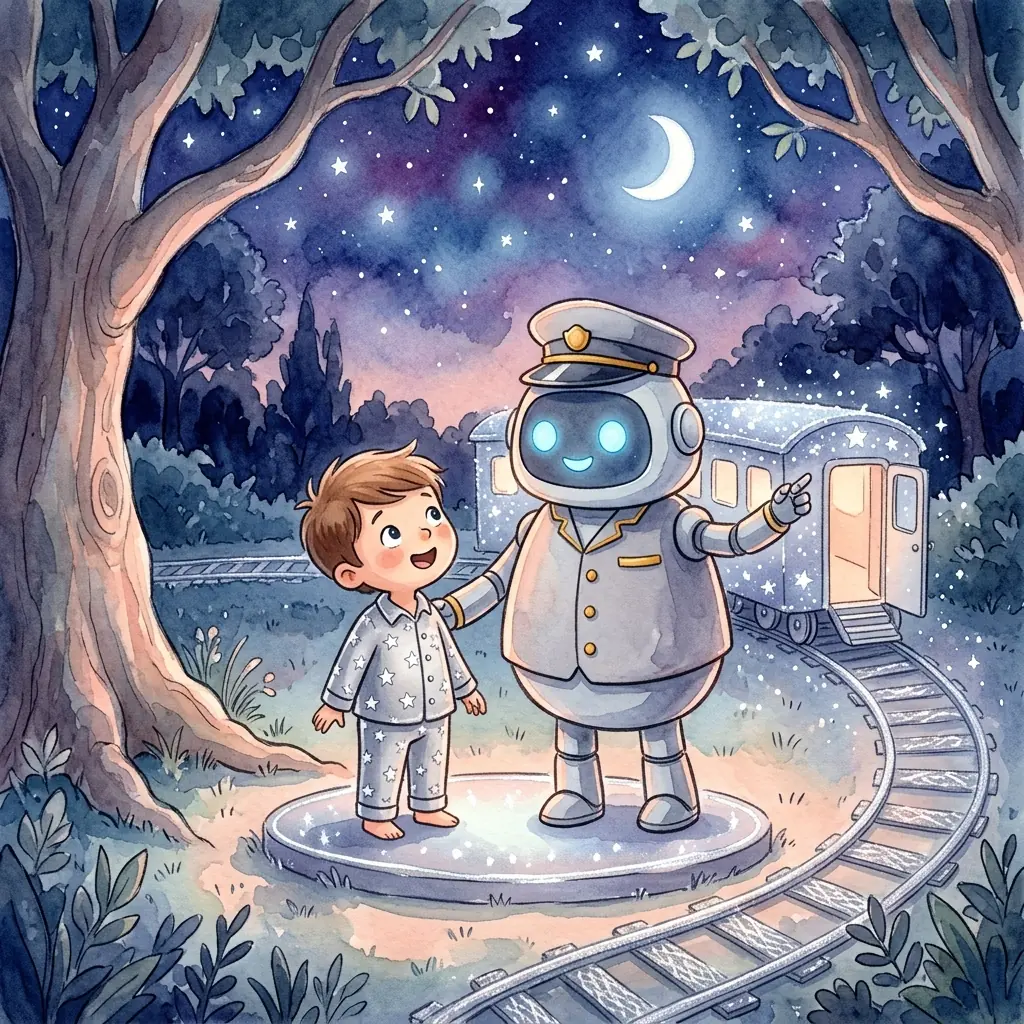 Ages 3-4
Sam’s Midnight Star Train
Sam follows a soft toot to a hidden train station and rides the Starlight Express through the sky and back to bed — a full-cast audio bedtime story.

The Goldilocks Effect: What fMRI Reveals About Audio, Illustration, and Animation
The researchers called it the "Goldilocks Effect." Animation was "too hot" (overstimulating). Audio was "too cold" (demanding). The illustrated book was "just right." But for bedtime, "too cold" is exactly what you want.
The study, led by John Hutton at the Reading and Literacy Discovery Center, tracked functional connectivity across five brain networks in children ages 3 to 5. Functional connectivity measures how well different brain regions talk to each other. It's the neural equivalent of teamwork.
| Brain Network | Audio-Only | Illustrated Book | Animated Cartoon |
|---|---|---|---|
| Language | High (cognitive strain) | Balanced (scaffolded) | High but fragmented |
| Visual Perception | Minimal (no external visuals) | Moderate (static images) | Peak (dominates resources) |
| Visual Imagery | High (internally driven) | Optimal (integrated) | Minimal (externally supplied) |
| Default Mode (DMN) | Moderate (reflection active) | High connectivity | Suppressed |
| Comprehension | High recall, high fatigue | Highest integration | Lowest retention |
The implication for bedtime is straightforward. Animation gives the brain nothing to do, and a brain with nothing to do doesn't wind down. It zones out. Audio gives the brain just enough to do: imagine, reflect, integrate. That's the cognitive state that transitions naturally into sleep.
A follow-up study using structural MRI found that children with higher screen exposure had lower white matter integrity in brain regions critical for language and literacy. Children with regular audio and reading exposure showed the opposite pattern: higher activity in the parietal-temporal-occipital (PTO) hub, the region that integrates visual and language inputs for long-term comprehension.
The Imagination Gap: What Screens Take Away
Screens don't just fail to build imagination. They predict worse imagination over time. Longitudinal research by Suggate and Martzog tracked preschoolers' screen-media habits and measured their mental imagery performance two years later.
Children with higher animated content consumption showed slower response times on mental comparison tasks, reduced accuracy on mental transformation tasks, and a measurable suppression of the imagery system over time. The theory: screens take over the work of image generation. The brain defaults to expecting images to be provided rather than building them internally. The imagery muscle weakens from disuse.
Audio stories reverse this pattern. Every time a child hears "the dragon circled the tower," their brain has to decide what the dragon looks like, how large the tower is, what color the sky is, and where their mental camera is positioned. That's not passive entertainment. That's cognitive construction.
| Factor | Audio Stories | Animated Media |
|---|---|---|
| Imagery generation | Active (internally driven) | Passive (externally provided) |
| Cognitive effort | Effortful construction | Effortless reception |
| Developmental trajectory | Strengthens visualization over time | Correlated with reduced imagery performance |
| Empathy activation | High (requires emotional simulation) | Lower (visual cues may bypass reflection) |
This internal simulation is also the mechanism behind narrative "transportation," the feeling of being inside a story. Research links transportation to higher empathy, stronger perspective-taking, and better problem-solving. Children who build their own story worlds develop a deeper relationship with narrative than children who consume pre-built ones.
Listening Isn't Cheating: Audio Stories and Literacy
The semantic representations evoked by listening and reading are nearly identical. The brain processes spoken and written language through the same cognitive and emotional regions. An audiobook activates the same meaning-making networks as a printed page. The input channel is different. The comprehension machinery is the same.
For most children, this means audiobooks are a legitimate complement to reading. For some children, they're transformative.
Dyslexia affects roughly 1 in 5 students. For these children, the page is a barrier between their mind and the story. Audiobooks remove the barrier. Hearing words pronounced correctly in context helps children internalize new vocabulary more effectively than encountering words on a page they can't decode. Professional narrators model proper tone, pacing, and inflection, reinforcing how language works. And audiobooks let children with reading disabilities engage with the same literature as their peers: joining discussions, forming opinions, developing analytical thinking.
Research on "multisensory reading" (following printed text while listening) shows significantly higher comprehension scores for struggling readers and English as a Foreign Language students. The audio provides scaffolding while the eyes track the text, reinforcing the connection between spoken and written language.
Audio stories don't replace reading. They unlock it. Especially for the children who need stories most.
Hear it for yourself
Hear what an audio bedtime story sounds like: a calm voice, your child as the hero, and a gentle ending. No signup required.
The $2.2 Billion Shift: Why America Is Listening
If the neuroscience makes the case for audio, the market confirms it. Total US audiobook sales hit $2.2 billion in 2024, up 13% year-over-year. Five-year revenue growth exceeded 80%. Approximately 134 million Americans listened to an audiobook last year.
The children's segment is leading the charge. Children's and young adult audiobook sales grew 26% in 2024, the fastest-growing category in the industry. Libraries reported increased spending on physical audio materials for children, driven by devices like Playaway and integrated print-plus-audio products like Vox Books.
The primary driver? Parents searching for screen alternatives. Surveys show the number-one reason parents choose audiobooks over video is to give their children a "break from screens."
This isn't confined to audiobooks. The broader audio landscape (podcasts, screen-free players, sleep-story apps) is reshaping how children consume narrative content. The kids' podcast market is projected to reach billions by 2033, with 49% of US children ages 6 to 12 having listened to a podcast and bedtime stories ranking among the top genres.
Screen-Free Hardware: Why Yoto and Toniebox Are Booming
The most visible evidence of the audio shift is the screen-free audio player. Two devices dominate the category.
Toniebox
A tactile speaker where children place figurines ("Tonies") on top to trigger stories and music. Revenue hit EUR 321.8 million in the first nine months of 2025, up 33% year-over-year. Children average 280 minutes of listening per week. Strategic partnerships with Disney and Hasbro have expanded their content library to hundreds of characters.
Yoto
A card-based audio player with a pixel art display and no video. Projected to reach $600 million in annual recurring revenue in 2025. The "Make-Your-Own" cards let parents and grandparents record their own voices or upload audiobook files.
Both devices succeed for the same reason: they give children the autonomy of digital media (press a button, hear a story) without the addictive properties of screens. No scroll. No autoplay. No algorithm deciding what comes next. Reviewers describe the experience as "old-timey magic."
For parents who already own these devices, personalized AI audio stories fill a gap. Yoto and Toniebox play stories, but they don't create them. A personalized audio story starring your child, generated in minutes, downloadable to any device, is the content layer that makes screen-free hardware personal. We wrote a full cost breakdown of Toniebox vs Yoto if you're considering the hardware.
Why Voice Quality Matters More Than You Think
Not all audio is equal. The quality of narration significantly impacts engagement, comprehension, and emotional connection. Consumer surveys by the Audio Publishers Association show a consistent preference for human narrators over AI-generated voices. For children, the nuances matter even more.
Professional narrators use a wide range of characters, accents, and emotions to maintain narrative flow. A skilled narrator prevents children from "falling out" of the story, which is especially important at bedtime, when attention is fading. Research suggests most listeners prefer a single talented narrator who differentiates voices through subtle shifts in tone over excessive sound effects and music, which can be distracting. (We explored this in our comparison of narrator vs full cast voice styles.)
Parental reading remains the gold standard for emotional bonding, especially for infants and toddlers. The parent's voice carries emotional weight that no recording can replicate.
Library purchasing decisions confirm this: narrator quality is cited as a top factor because a poor performance leads to immediate disengagement. For bedtime, where the goal is sustained, calm attention, voice quality isn't cosmetic. It's functional.
Audio and Sleep: The Direct Connection
Approximately 90% of studies link youth screen media use to delayed bedtime and decreased total sleep time. The mechanisms (blue light suppressing melatonin, psychological overstimulation, displacement of sleep time) are well-documented. We covered this in detail in our post on what screens do to your child's brain before bed.
Audio stories address all three mechanisms.
No melatonin suppression
Screen-free audio doesn't emit blue light. The brain's natural circadian rhythm continues uninterrupted. No 50-minute melatonin recovery window like you get after tablet use.
Lower physiological alertness
The rhythmic structure of spoken language and calm narration styles help children wind down. Research on the Moshi app (an audio-based sleep aide) found that substituting screens with audio stories significantly improved sleep health in children aged 4 to 8.
Natural routine integration
Audio stories fit seamlessly into the wind-down sequence: bath, pajamas, story, sleep. There's no "one more episode" autoplay. The story ends and the room is quiet. This consistency is a key recommendation for managing behavioral insomnia of childhood, which affects a significant percentage of preschoolers.
The pre-bed medium matters. Audio works with the body's sleep architecture instead of against it.
Audio Stories, Made for Bedtime
The fMRI research says audio builds imagination. The Suggate data says it strengthens visualization over time. The market says 134 million Americans are already listening. And the sleep research says the pre-bed window needs to be protected.
Bedtime Stories was built on that evidence. You enter a name, choose a theme, pick a voice. The AI generates a personalized story with cover art in under three minutes. At bedtime, you press play. Your child hears themselves as the hero of a story that was made just for them.
- 100+ professional voices, from warm storytellers to character voices (wizard, dragon, princess), plus custom voice upload (7 languages) so parents and grandparents can narrate in their own voice. Choose the voice that matches your child's mood and the story's tone.
- Full-cast mode with up to 6 different character voices in a single story. The dragon sounds like a dragon. The fairy sounds like a fairy.
- No screen required at bedtime. Create the story during the day. Play the audio at night. The phone stays in the other room.
- Downloadable audio. Save stories for car rides, flights, camping, or grandma's house. Works with Yoto, Toniebox, or any Bluetooth speaker.
- No subscription. Pay per story. Credits never expire.
Common Questions
Are audiobooks good for kids?
Yes. Neuroscience shows that the semantic representations evoked by listening and reading are nearly identical. Audiobooks activate the same meaning-making networks as printed text. For children with dyslexia or reading difficulties, audiobooks remove the decoding barrier and let them engage with stories at their intellectual level.
Do audio stories help kids fall asleep?
Audio stories address all three mechanisms that make screens harmful before bed: they emit no blue light, they lower physiological alertness through rhythmic narration, and they integrate naturally into wind-down routines without autoplay or "one more episode" loops. Research on the Moshi app found that substituting screens with audio stories improved sleep health in children aged 4 to 8.
What is the Goldilocks Effect in children’s media?
The Goldilocks Effect comes from a 2018 Cincinnati Children’s Hospital fMRI study. Researchers found that animated video was "too hot" (overstimulating the visual cortex), audio was "too cold" (cognitively demanding), and illustrated books were "just right" for balanced brain activation. For bedtime, the demanding quality of audio is actually ideal because it engages the brain enough to wind down without overstimulating it.
Is listening to a story the same as reading one?
Nearly. Brain imaging studies show that listening and reading activate the same cognitive and emotional regions for comprehension. The input channel differs (ears vs eyes), but the meaning-making machinery is the same. Audiobooks are a legitimate complement to reading, not a shortcut.
Are screen-free audio players like Toniebox worth it?
Screen-free players like Toniebox and Yoto give children autonomy over their audio experience without addictive screen properties. Toniebox reported EUR 321.8 million in revenue for the first nine months of 2025. The main limitation is content: these devices play pre-made stories but don’t create personalized ones. AI story apps complement them by generating stories starring your child.
Your child's brain doesn't need more pixels. It needs more words. Tonight, try an audio story instead of a video. Close the screen. Press play. And let their imagination do what it was built to do.
Peer-Reviewed Research
- Differences in Functional Brain Network Connectivity During Stories in Audio, Illustrated, and Animated Format (Hutton et al.)
- Screen Usage Linked to Differences in Brain Structure in Young Children (Cincinnati Children’s)
- Preschool Screen-Media Usage Predicts Mental Imagery Two Years Later (Suggate & Martzog)
- Does It Kill the Imagination Dead? The Effect of Film vs Reading on Mental Imagery
- Youth Screen Media Habits and Sleep: Recommendations for Clinicians (PMC)
- Out Like a Light: Feasibility of an Audio-Based Sleep Aide for Children (Moshi Study)
- Substituting Book Reading for Screen Time Benefits Preschoolers’ Sleep Health (PMC)


