Preparing Your Child for a New Baby: A Bedtime Story and What to Say
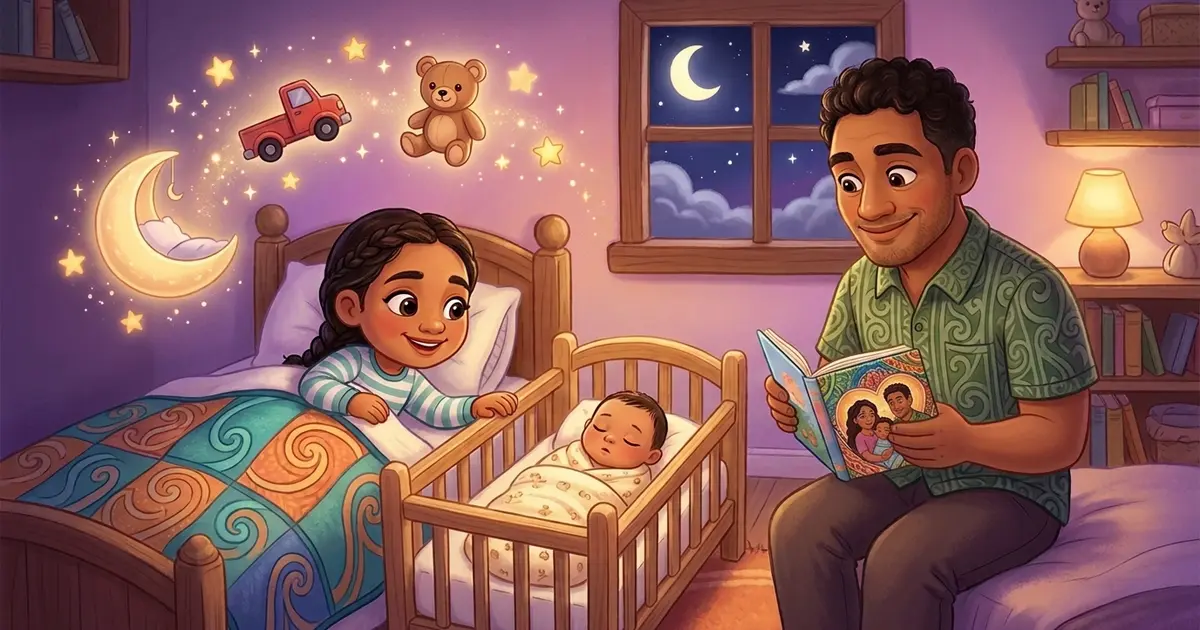
To prepare a child for a new baby, tell them plainly a few weeks ahead, say what a newborn really does, name what stays the same and give them a small job. This guide includes a short read-aloud story about a new sibling, what to say after the birth and how to protect the bedtime story.
$2 per story. No subscription.
A young child cannot picture a baby who does not exist yet. What helps is a few short, calm talks before the birth, a story that shows the change from the older child's side, and one thing that stays the same every night. This guide gives you all three, including a story you can read aloud tonight.
The same idea works for any big change: a story lets your child rehearse what is coming and hear that their feelings are allowed. For the research behind it, see our guide to preparing kids for big moments.
Before the Baby Arrives
- Tell it plainly, and tell it yourself. “There is a baby in my tummy. The baby will come to live with us.” Use the real words. Young children take in the facts and ask the same question ten times, which is fine.
- Be honest about what a newborn does. A newborn sleeps, feeds and cries. Say so. A child promised a playmate is let down on day one.
- Say what stays the same. Name two or three fixed things: who takes them to nursery, bath time, the story at night. Children cope with change better when something is predictable.
- Give your child a job. Choosing a blanket, helping fold tiny clothes or picking the song for the baby makes the baby partly theirs. Keep the job small and optional.
- Plan who stays with them. Tell your child who will be home while you are at the hospital, and let them meet that person beforehand. Show a photo of the hospital if you can.
- Move big changes early. A new bed, a new room or giving up a pacifier goes better months before the birth, so the baby does not get the blame.
A Bedtime Story About a New Baby
This story is short, a bit funny and honest about the hard part. Milo is allowed to feel left out. Swap in your child's name and your child's favorite toy. Read it a few times in the weeks before the birth.
The Baby Who Lives at Our House
About 3 minutes, 330 words. Ages 2-6. Change the names to yours.
Milo had a red truck, a blue blanket and a mama and a papa who read to him every night.
One day Mama said, “There is a baby growing in my tummy. Soon the baby will come to live at our house.”
“Will the baby have my truck?” asked Milo.
“No,” said Mama. “The truck is yours. The baby is too small to drive a truck. The baby can only sleep, drink milk and make small noises.”
Milo thought about that. “That sounds boring,” he said.
“A little,” said Papa, and they all laughed.
The weeks went by. Mama’s tummy got round. Milo helped Papa put a small bed in the corner of the room. He put his oldest, softest bear inside it.
Then one night, Mama and Papa went away to the hospital, and Grandma came to stay. Milo slept with his blue blanket and dreamed of trucks.
In the morning, Papa came home and said, “She is here.”
Milo got to meet the baby. She was very small. She had tiny fingers and a very loud cry. She did not look at his truck at all.
“Hello,” whispered Milo. The baby wrapped her whole hand around his finger and held on.
“She likes you,” said Papa.
The first days were busy. Mama was tired. The baby cried a lot, and sometimes Milo felt a bit left out. He said so, out loud, to Mama. “I don’t like it when you hold her all day.”
Mama did not say he was wrong. She said, “I know. It is a big change. Come here.” And she made room on her lap for both of them.
That night, Papa read Milo his story, just like always. The baby slept in her small bed in the corner, with the old soft bear.
“Papa,” said Milo, “when she is bigger, can I show her my truck?”
“I think she would love that,” said Papa.
Milo smiled. He had a red truck, a blue blanket, a mama and a papa, and now a little sister who held on to his finger. He shut his eyes, and the house was quiet.
Hear it for yourself
Listen to a complete bedtime story with calm narration and a gentle ending. No signup required.
After the Baby Comes Home
Expect mixed feelings
Many older children love the baby and resent the baby in the same hour. You may see clinginess, tantrums, trouble sleeping or a step back in toilet training. This is a common reaction to a big change, and it usually settles as the new routine does. Name the feeling and keep the limit: “You are cross that I am feeding the baby. You can be cross. You may not hit.”
Protect the bedtime story
Bedtime is when your older child is most likely to feel the loss of you. Keep the story, even if it is one short story. Some ways to make it work with a newborn:
- Start the story first, then feed the baby. Your child falls asleep to the sound of your voice.
- Use an audio story on the nights you cannot sit down, and stay in the room.
- Split the evening when two parents are home: one does the baby, one does the story, and you swap every other night.
- Make the baby part of the story sometimes, as a character who “looks up to” the big sibling. Never every night.
For the larger picture of the evening, see our bedtime routine guide.
A Story About Your Own Family
A ready-made story is a good start. A story with your child's own name, toy and home often lands better. In Bedtime Stories:
- Pick your child's age and a real-life story type.
- Type a theme such as “getting a new baby brother”.
- Add your child as the hero, and the baby if you want.
- Use the special instructions for the details that matter: “Mama is tired but still reads at bedtime; the baby sleeps in a small bed in the corner”.
- Narrated by any of our 100+ voices, in 50+ languages, ready in about two minutes.
- Read it first. The full text comes with the audio, so you can check the story before your child hears it.
- No subscription. Stories start at $2 each. Credits never expire.
Other big changes work the same way. See a story for a first dentist visit and a story for moving house.
Common Questions
When should I tell my child about a new baby?
For a toddler, a few weeks before the due date is usually enough, because a young child has little sense of months. Older children can be told earlier, often once you have told family. Tell your child yourself, before someone else lets it slip, and then bring the baby up in small ways: a book, a story, a visit to a friend with a baby.
What should I say to a toddler about a new baby?
Keep it short and concrete. Say what will happen and what stays the same: “The baby will live with us. The baby will sleep a lot and cry sometimes. Mama and Papa will still read you a story every night.” Avoid promising that the baby will be a playmate soon, because a newborn will not play for months.
My child is jealous of the new baby. Is that normal?
Yes. Mixed feelings are common, and they often show up as clinging, tantrums or a return to baby behavior such as asking for a bottle. Name the feeling without judging it (“You wish I was holding you right now”), give your child one-on-one time, and let the behavior pass. If it is severe or lasts for months, mention it to your pediatrician.
How do I keep the bedtime story going with a newborn?
Keep the same slot and the same order, even if it is shorter. If you are feeding the baby at bedtime, an audio story lets your older child still have a story with you in the room. Alternate nights if both parents are home: one parent does the baby, one does the story.
Can I make a story about our own new baby?
Yes. In Bedtime Stories, add your child as the hero, type a theme such as “getting a new baby sister” and put the family details in the special instructions, for example that the baby sleeps in a small bed in the corner. Pick one of 100+ voices. The narrated story is ready in about two minutes, in any of 50+ languages, and you can read the text first.
You cannot make a big change small. You can make it familiar. A few honest sentences, a story at night and your full attention for ten minutes a day go a long way.