AI Personalized Bedtime Stories: How They Work & Which Apps Do It Best (2026)

AI personalized bedtime stories use artificial intelligence to create unique narratives where your child is the main character. Unlike pre-written templates, AI generators craft original plots using your child’s name, age, and interests, producing a new story with professional voice narration in under five minutes. We tested 7 apps and compared them on voice quality, personalization depth, safety, and price.
$2 per story. No subscription.
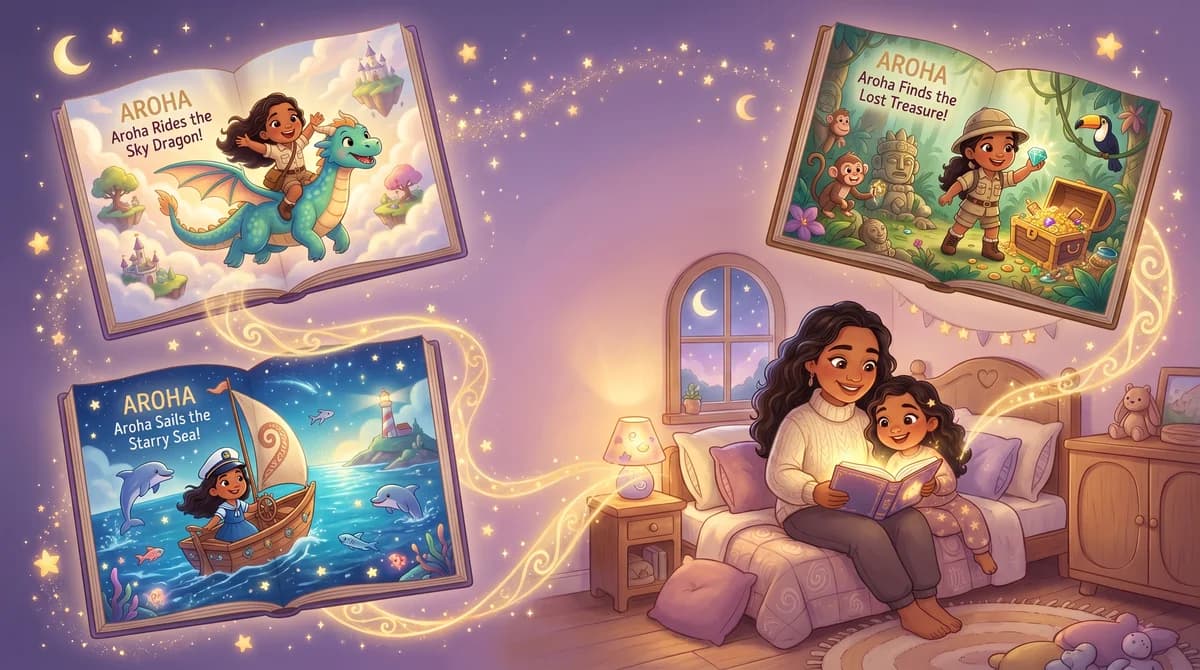
Your child doesn't want to hear a bedtime story. They want to hear their bedtime story: the one where they ride a dragon, where their pet hamster talks, where their little sister tags along on a space mission. AI personalized bedtime stories make that possible. And the technology has gotten remarkably good in the past year.
What Are AI Personalized Bedtime Stories?
AI personalized bedtime stories are children's narratives generated by artificial intelligence that place a specific child at the center of the plot. Using large language models trained on children's literature, these apps take a child's name, age, interests, and family details as inputs and produce a unique story with age-appropriate vocabulary, illustrations, and often professional voice narration in under five minutes.
Unlike traditional personalized books where a child's name is inserted into a pre-written template, AI personalized stories generate entirely original plots. Each story is different. The child isn't pasted into someone else's adventure. The adventure is built around them.
This distinction matters. According to Prof. Ying Xu at Harvard's Graduate School of Education, children learn most effectively from AI-generated content when it follows established developmental principles: narrative structure, repetition of key concepts, emotional engagement, and vocabulary calibrated to the child's stage. Name-only personalization misses three of those four principles. True AI personalization can address all of them.
How AI Personalized Stories Actually Work
Most parents don't need to understand the engineering. But knowing the basics helps you evaluate which apps are doing personalization well and which are faking it.
Step 1: Input collection
The parent provides details: child's name, age, gender, interests, siblings, pets, a theme or lesson they want the story to address. Some apps collect this through a wizard (a step-by-step form), others through a chat interface, and a few through photo uploads.
Step 2: Story generation
A large language model (the same class of AI behind tools like ChatGPT) generates a narrative using the parent's inputs as constraints. The better apps use models fine-tuned specifically on children's literature, which means they understand story structure, age-appropriate vocabulary, and pacing. According to Prof. Ying Xu's research at Harvard, children learn most effectively from AI systems designed with established learning principles, including narrative structure, repetition, and emotional engagement.
Step 3: Character consistency
The most advanced apps maintain character consistency across the story. If your child has brown hair and a red jacket, that character looks the same on page 1 and page 15. Some platforms achieve this through photo-to-character technology (the parent uploads a photo and the AI generates a consistent illustrated version). Others use detailed text descriptions fed to the image model at each generation step.
Step 4: Voice narration
Many apps now include AI voice narration. The quality range is enormous: from basic text-to-speech that sounds robotic to professional-grade voices that are indistinguishable from a human narrator. The best systems offer multiple voice options and "full cast" modes where different characters have distinct voices.
Step 5: Safety filtering
Responsible platforms run generated content through multiple safety layers, checking for inappropriate themes, violence, scary content, and age-inappropriate language before the story reaches the child. For a deeper look at what to check for, see our AI safety guide for parents.
The entire process, from parent input to finished story with audio and illustrations, takes between 30 seconds and 5 minutes depending on the platform.
Why Kids Love Being the Hero
Children are more engaged when they see themselves in the story. This isn't just a hunch. Research in developmental psychology consistently shows that self-referential processing (encountering your own name, your own likeness, your own context in a narrative) increases attention, recall, and emotional connection.
According to researchers studying children's interactions with AI storytelling tools, children demonstrate higher engagement and longer attention spans when they are the protagonist of a story compared to when they listen to generic narratives. The effect is strongest in children ages 3 to 8, where the boundary between fiction and personal experience is naturally more fluid. This is the same brain-building power that makes bedtime stories so valuable, amplified by personal connection.
Prof. Ying Xu's research at Harvard has identified four key factors that make AI-generated stories effective for children:
- Narrative structure that follows age-appropriate story arcs (setup, conflict, resolution)
- Repetition of key concepts woven naturally into the plot
- Emotional engagement through personal connection to the characters
- Appropriate vocabulary calibrated to the child's developmental stage
The implication for parents: not all AI personalization is equal. An app that plugs your child's name into a generic template is fundamentally different from one that builds a story around your child's specific world: their siblings, their pet, their fear of the dark, their love of dinosaurs. The best apps use all four of these principles. The mediocre ones just do the name insertion.
What to Look For in a Personalized Story App
Before comparing specific apps, here are the features that separate genuine personalization from surface-level name-swapping:
| Feature | What to Look For | Why It Matters |
|---|---|---|
| Personalization depth | Does the child appear as a named character, or as the actual protagonist? Can siblings, pets, and friends be included? | Name-only personalization feels hollow by the third story. Deep personalization keeps the child engaged long-term. |
| Age-appropriate vocabulary | Does the app adjust language complexity for different ages? | A story for a 4-year-old should not read like a story for a 10-year-old. |
| Voice quality | Is there audio narration? How many voice options? Full cast or single narrator? | Voice is what makes a bedtime story a bedtime story. Robotic TTS breaks the spell. |
| Character consistency | Does the illustrated character look the same across all images? | Inconsistent characters confuse young children and break immersion. |
| Content safety | Multi-layer filtering? COPPA compliance? Ad-free? | Non-negotiable for any app your child uses. |
| Pricing model | Subscription, credits, or free? What does 1 year of regular use cost? | The monthly price and the annual cost are very different numbers. |
| Offline access | Can stories be downloaded and replayed without internet? | Bedtime happens in bedrooms, cars, and at grandma’s house. Not all have Wi-Fi. |
7 AI Personalized Story Apps Compared (2026)
We tested seven apps that offer AI-personalized bedtime stories. Here's how they compare on the features that matter most. For an even broader roundup that includes non-personalized apps, see our best bedtime story apps guide.
| Feature | Bedtime Stories | Fable | Scarlett Panda | Oscar Stories | StoryBee | Sleepytale | Magic Story Machine |
|---|---|---|---|---|---|---|---|
| Child as protagonist | Yes | Yes (photo) | Yes (up to 4) | Yes | Yes | Yes | Yes |
| Photo-to-character | No | Yes | No | No | No | No | No |
| Age vocabulary levels | 4 levels (3–12) | Age-adaptive | Newborn to 14 | Educator-reviewed | Age ranges | Age ranges | Basic |
| Voice narration | 100+ voices + custom upload (7 languages) | AI narration | Audiobook | Soothing narrator | Voice cloning | AI "Avery" | Basic TTS |
| Full cast mode | Yes (6 voices) | No | No | No | No | No | No |
| Languages | 7 languages | English | 74 languages | Multiple | Multiple | English | English |
| Generation time | ~3 min | ~30 sec | ~30 sec | ~1 min | ~2 min | ~1 min | ~1 min |
| Offline download | Yes (audio) | No | No | Limited | No | No | No |
| Content safety | Age-adapted prompts, parent preview | Parental controls | Age filtering | Educator-reviewed | Content filtering | Content filtering | Basic |
| Pricing | $2/story | $5.99/mo | $9.90/mo | $4.99/mo | $7–29/mo | $6–17/mo | $2.49/mo |
| Annual cost (1x/wk) | ~$104 | $71.88 | $49–119 | $40–60 | $84–348 | $72–204 | $29.88 |
| Free tier | Sample story | Limited | 1 free story | Free trial | Limited | Free library | Limited |
Annual cost assumes one story per week (52 stories/year). Subscription apps include unlimited stories within their tier. Pay-per-use pricing scales with consumption.
Hear it for yourself
Hear the difference 100+ professional voices make. Listen to complete sample stories with full-cast narration. No signup required.
App-by-App Reviews
Here's an honest look at each app. Competitors first, our product last. Same format for every review. For an even deeper dive into AI bedtime story generators, see our 8-app comparison.
Fable: The Photo-to-Character Pioneer
What it is: A mobile app that uses photo-to-character technology to place your child directly into illustrated stories. Upload a photo, and Fable generates a consistent illustrated version of your child that appears throughout the narrative.
What it does well
The photo-to-character feature is Fable's standout. Your child sees themselves (their actual likeness, not a generic avatar) in the story illustrations. Generation is fast (approximately 30 seconds). The visual quality is high, and character consistency across illustrations is strong. At $5.99/month, it's competitively priced for the category.
What it doesn't do well
The voice narration is AI-generated but limited in variety. There's no selection of dozens of voices or full-cast mode. The experience is primarily visual (illustrations plus text) with audio as a secondary feature. No offline download for audio files. English-only.
Pricing: $5.99/month. Limited free tier.
Best for: Parents who want their child to see themselves in the story. The photo-to-character technology creates a "wow" moment that text-only personalization can't match.
Scarlett Panda: The Developmental Toolkit
What it is: A "holistic child development platform" offering AI-generated personalized stories, learning adventures, meditations, and lullabies in 74+ languages.
What it does well
Scarlett Panda goes beyond bedtime into developmental territory. Its fine-tuned model can generate stories addressing neurodiversity, pet loss, anxiety, moving to a new school, or any emotionally complex situation a child might face. According to the platform, stories can be generated in approximately 30 seconds with up to 4 characters included. The 74-language support is unmatched for multilingual families. Carbon-neutral operations and optional physical printed copies are thoughtful touches.
What it doesn't do well
At $9.90/month (or $49/year), it's priced as a premium tool. The breadth of features (meditations, learning adventures, lullabies) means the storytelling experience is less focused than dedicated story generators. The audiobook narration is functional but not the platform's primary differentiator.
Pricing: $9.90/month or $49/year.
Best for: Parents dealing with specific emotional or developmental situations who want stories tailored to their child's challenges. Excellent for multilingual families.
Oscar Stories: The Classic Literature Remix
What it is: A mobile app that places your child inside classic literary worlds: Alice in Wonderland, The Jungle Book, Grimm's Fairy Tales.
What it does well
Oscar's hook is brilliant. Your child doesn't just get a personalized story; they get a personalized story inside a world they might already know. The app was developed with educators and includes moral selection (empathy, responsibility, kindness). According to Oscar's team, classic tale integrations allow children to interact with beloved characters while learning embedded moral lessons. The illustrations are warm and child-friendly. For families who already enjoy bedtime fairy tales, Oscar adds a personalization layer on top.
What it doesn't do well
Voice options are limited. There's a narrator style, but nothing approaching multiple character voices. The classic literature angle constrains story settings. The pricing model (coins plus subscription) can be confusing.
Pricing: $4.99/month or $39.99/year. Coin packs available.
Best for: Parents who value literary heritage and want their child woven into classic tales. Strong for families who already read traditional fairy tales at bedtime.
StoryBee: The Voice Cloning Option
What it is: A story generation platform offering tiered subscriptions from basic to premium, with voice cloning available at higher tiers.
What it does well
StoryBee's tiered pricing ($7 to $29/month) lets families choose the feature set that matches their budget. The voice cloning feature at the premium tier means a parent, grandparent, or family member can narrate stories in their own voice, even when they're not present. That's a powerful tool for long-distance families.
What it doesn't do well
The price range is wide and the tier differences can be confusing. The base tier at $7/month is competitive, but voice cloning at $29/month makes it one of the most expensive options in the category.
Pricing: $7 to $29/month depending on tier.
Best for: Families who want voice cloning capability and are willing to pay a premium for it.
Sleepytale: The Narration Specialist
What it is: An AI narration platform featuring "Avery," a built-in AI storytelling nanny, plus voice cloning and illustrated picture book output.
What it does well
Sleepytale focuses on the narration experience. The "Avery" narrator is warm and soothing, designed specifically for bedtime. According to the platform, parents can choose from multiple narrator voices, and the output includes picture book-style illustrations alongside audio. Cross-platform support (phones, tablets, CarPlay, smart watches) is the widest in the category.
What it doesn't do well
Voice cloning requires the Pro Plus tier ($17/month), making full features expensive. The personalization depth (how much of the child's world is woven into the story) is less granular than some competitors. No offline audio download in the standard configuration.
Pricing: Free public library. Pro: $6 to $12/month. Pro Plus: $17/month (voice cloning).
Best for: Parents who prioritize narration quality and want a "press play" bedtime experience. Long-distance families benefit from voice cloning.
Magic Story Machine: The Budget Pick
What it is: A budget-friendly AI story generator targeting parents who want basic personalized stories at the lowest possible cost.
What it does well
At $2.49/month on an annual plan, Magic Story Machine is the cheapest subscription option in the category. It generates personalized stories with the child's name and basic customization. For families who want a "good enough" AI story without premium pricing, it fills the gap.
What it doesn't do well
The voice narration is basic text-to-speech: functional but clearly robotic. Personalization depth is limited compared to premium platforms. Content safety filtering is less sophisticated. English-only.
Pricing: $2.49/month on annual plan ($29.88/year).
Best for: Budget-conscious families who want to try AI personalized stories without committing to a $5 to $10/month subscription.
Bedtime Stories (bedtime-stories.fun): Full-Cast Audio
What it is: A web-based story generator that creates personalized audio stories with 100+ professional voices, full-cast narration, AI cover art, and downloadable audio, with no subscription required.
Full disclosure: this is our product. Same format as every other review.
What it does well
Three things differentiate Bedtime Stories from the rest of this list.
First, the voice system. 100+ professional voices powered by ElevenLabs, plus custom voice upload (7 languages) so parents and grandparents can narrate in their own voice. Not robotic text-to-speech, but human-quality narration. In Full Cast mode, up to 6 different character voices narrate the story. A dragon sounds like a dragon. A princess sounds like a princess. No other app in this comparison offers multi-character voice casting at this scale. You can browse all 100+ voices before creating a story.
Second, the personalization structure. The child is the protagonist of every story, not a cameo. The 7-step creation wizard collects age, story type, characters (including siblings, friends, and pets), voice selections, theme, and location. Four age-specific vocabulary levels (3-4, 5-6, 7-8, 9-12) ensure the language matches the child's development.
Third, the pricing model. No subscription. $2 for a single story, $8 for five, $15 for ten. Credits never expire. A family that uses it once a week spends roughly $104/year. A family that uses it twice a month spends $48/year.
Every story includes AI-generated cover art, a full text transcript for read-along, and a downloadable audio file that works offline on any device.
What it doesn't do well
No photo-to-character technology. The child's likeness doesn't appear in illustrations (the cover art is thematic, not portrait-based). No voice cloning. No dedicated mobile app (it's web-based with downloadable audio). No interactive branching. At $2/story, heavy daily use is more expensive than an unlimited subscription ($730/year for daily use vs. $50 to $120/year for most subscriptions).
Pricing: $2/story. $8 for 5 stories. $15 for 10 stories. No subscription.
Best for: Parents who want the highest-quality audio narration experience and hate subscriptions. Ideal for families who use it 1 to 3 times per week and want each story to feel like a private audiobook production.
The Real Cost Over a Year
Monthly prices are misleading. What matters is what a family actually spends over a year based on how often they use the app. Here's the math for three usage patterns:
| App | 1 story/week | 2 stories/week | Daily use |
|---|---|---|---|
| Magic Story Machine | $29.88/yr | $29.88/yr | $29.88/yr |
| Oscar Stories | $40–60/yr | $40–60/yr | $40–60/yr |
| Scarlett Panda | $49–119/yr | $49–119/yr | $49–119/yr |
| Fable | $71.88/yr | $71.88/yr | $71.88/yr |
| Bedtime Stories | ~$104/yr | ~$208/yr | ~$730/yr |
| StoryBee | $84–348/yr | $84–348/yr | $84–348/yr |
| Sleepytale | $72–204/yr | $72–204/yr | $72–204/yr |
Subscription apps win on daily use because the price is flat regardless of consumption. Pay-per-story wins on light-to-moderate use because you only pay for what you consume. There's no universally "cheapest" option. It depends on your family's cadence.
Making the Most of AI Personalized Stories
Whichever app you choose, a few practices make AI personalized stories more effective at bedtime:
Let the child help choose the theme
"Do you want a story about a dragon or about a space adventure?" Giving the child agency over the story's direction increases their investment in listening to it. Most apps support custom theme input.
Use the story to address real situations
Moving to a new school? A story where your child bravely navigates a new classroom normalizes the experience. According to child development research, narrative exposure to challenging situations reduces anxiety by providing a "rehearsal" in a safe context. For more on this approach, see our guide on preparing kids for big moments through stories.
Make it a routine, not a novelty
The first AI-personalized story is magical. The tenth is where the real value lives. The child comes to expect and anticipate their nightly story, and it becomes a reliable signal that bedtime has begun. This is the same principle behind any effective bedtime routine.
Listen together first
Before letting a child listen independently, listen to 2 to 3 stories yourself. Check that the content, vocabulary, and tone match your expectations. Every app on this list handles safety differently, and no approach is perfect.
Download for offline
If the app supports it, download audio files to the child's device. Bedtime stories shouldn't depend on Wi-Fi reliability. Downloaded audio also means no screen is required during playback. Transfer to a Bluetooth speaker and the phone can leave the room. This is what makes audio stories better than screens before bed.
Your Child's Story, Their Voice, Tonight
Every comparison in this post comes down to one question: which app gives your child the experience that makes them want to go to bed?
For Bedtime Stories, here's what that looks like in practice. You open the story wizard, select your child's age range (3-4, 5-6, 7-8, or 9-12), and the AI adjusts vocabulary, story complexity, and pacing to match. You pick a theme from the suggestions or write your own. You choose from 100+ professional voices, and if you select Full Cast mode, each character in the story gets their own distinct voice. Three minutes later, you have a complete audio story with cover art, a text transcript for read-along, and a downloadable file that works on any device.
- 100+ professional voices including Full Cast mode with up to 6 character voices per story
- Four age-specific vocabulary levels (3-4, 5-6, 7-8, 9-12) calibrated to your child's development
- Downloadable audio that works offline on any device. No screen needed at bedtime.
- No subscription. Stories start at $2 each. Credits never expire.