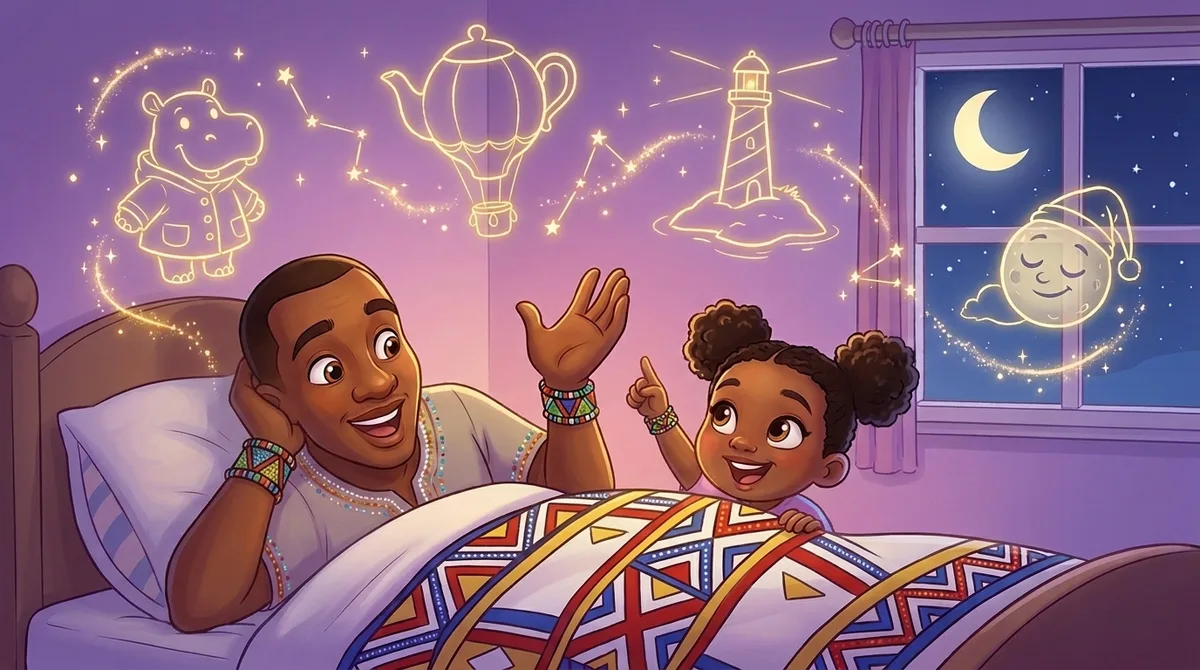
Sleeping Stories for Kids: Calming Tales for a Quiet Bedtime
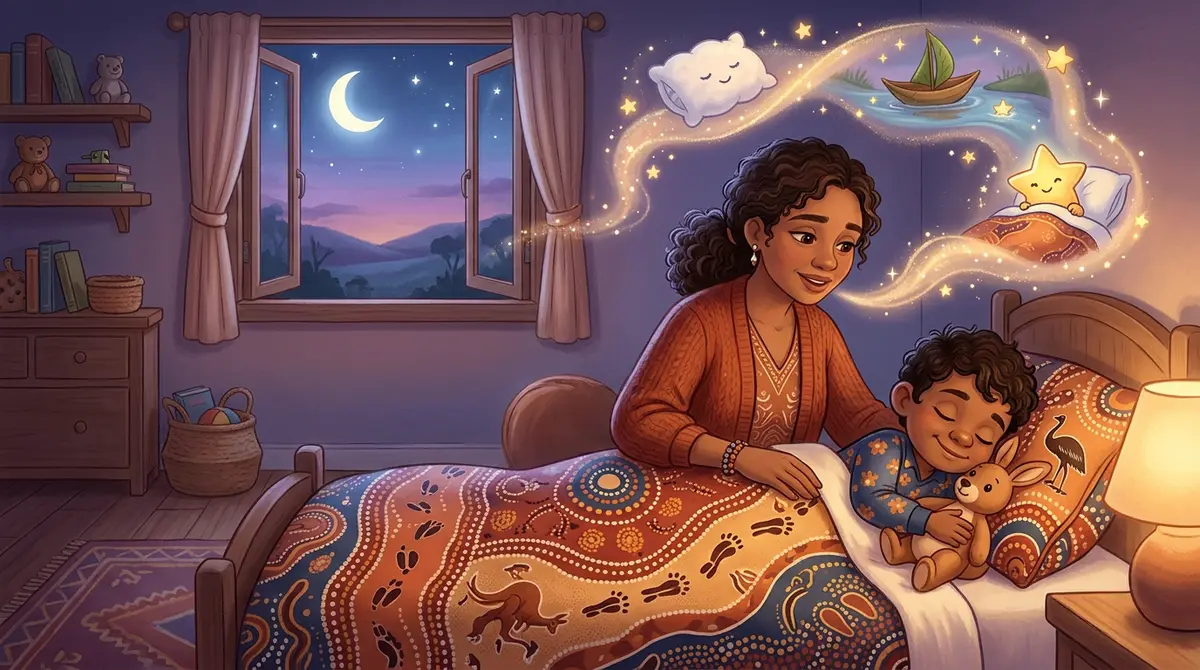
A sleeping story is a bedtime story built for sleep, not excitement: a slow pace, little or no conflict, soft sensory detail and an ending that fades into stillness. Many include small relaxation exercises in the plot, such as squeezing and releasing the hands or slow breathing. Read it slowly, in a low, even voice.
$2 per story. No subscription.
You know the moment. The routine went well, the lights are low, and you start a story about a knight who finds a secret door in the castle wall. Your child's eyes go wide. "What's behind the door?" Now they are sitting up. "Is it a dragon?" The story is working, and it is waking your child up.
You picked a daytime story. An exciting plot asks the brain to stay alert: what happens next, is the hero safe, how does it end? Those are good questions at four in the afternoon. At eight in the evening it can keep a child awake.
A sleeping story does the opposite. It is slow, low on conflict and full of soft detail, and it fades out instead of building to a climax. This guide explains what makes a story sleepy, gives you one to read aloud tonight, and lists eight story ideas, plus the free podcasts and apps worth knowing.
What Makes a Story a Sleeping Story
Your child's body has an accelerator and a brake. The accelerator (the sympathetic nervous system) gets them ready for action. The brake (the parasympathetic system) slows the heart and breathing and lets the body rest. Researchers who study children's sleep look at how well that brake works, and link it to how well children sleep.
A calm bedtime story gives the mind something easy to follow and nothing to worry about. It differs from an ordinary bedtime story in five ways:
| Story element | Sleeping story | Exciting story |
|---|---|---|
| Plot | A gentle journey or a quiet task, nothing to solve | A problem, a chase, a mystery to crack |
| Pace | Slow and even, with pauses | Speeds up towards the big moment |
| Detail | Warm, soft, quiet: sand, rain, moss, stars | Loud, fast, surprising: crashes, roars, shouts |
| Ending | Everything gets stiller until the story stops | A climax, then a quick resolution |
| The listener | Follows along loosely, eyes closed | Asks questions, sits up, wants more |
By daytime standards a sleeping story is a little boring, because nothing in it needs close attention. Exciting stories still belong in your child's life, earlier in the evening. A good order is a funny bedtime story or an adventure first, then the sleeping story last, with the lights down.
Repetition helps too. A survey of more than 10,000 mothers of children up to age five, across many countries, found that a consistent bedtime routine went with earlier bedtimes, falling asleep faster and fewer night wakings, and that the more nights a week families kept the routine, the better children slept. When the same kind of quiet story ends every evening, it becomes part of that routine: a signal that the day is over. Our bedtime routine guide shows where the story fits.
A Sleeping Story to Read Aloud Tonight
This one is written to be read slowly, in your quietest voice. It talks to your child directly ("you step onto the leaf"), so they are the one floating down the river. Three times it asks them to squeeze and let go, and twice to breathe. Do the movements with them. If they fall asleep before the pond, the story worked.
The Leaf Boat
A sleeping story, about 5 minutes read slowly. Ages 3-7. Pause where you see a breath.
At the bottom of the garden, where the long grass grows, there is a little river. It is a slow river. It is a warm river. And tonight, a big green leaf is waiting on the water, just the right size for you.
You step onto the leaf. It wobbles once, then holds you, soft and steady, like a hammock. You sit down. The river begins to carry you, very slowly, past the reeds.
The first thing you pass is a field of cotton flowers. They are white and round, like tiny clouds. As you float by, squeeze your hands into two tight little balls. Squeeze. Squeeze. And now let them go soft, as soft as the cotton flowers. Your hands are resting now.
The leaf drifts on. The water makes a quiet sound, shhh, shhh, against the side of your boat. Take a slow breath in through your nose, as if you are smelling the flowers. And let it out, long and slow, like a breeze across the water.
Next you pass a bank of warm sand. The sand has been in the sun all day, and it is still warm. Push your toes down, hard, as if you are pressing them into the sand. Push. Push. And now let them go. Your toes are heavy and warm. Your feet are resting now.
A frog sits on a lily pad, and it does not croak. It only blinks, slowly, once. Then it closes its eyes. An owl in a tall tree tucks its head under its wing.
The river goes around a gentle bend, and there is a grove of willow trees. Their long branches hang all the way down to the water, and they brush your shoulders as you float under them, soft as a blanket. Lift your shoulders up to your ears. Up, up. And let them drop. Your shoulders are resting now.
Breathe in. And breathe out.
The sky above the river is turning dark blue. One star comes out. Then another. Then another. You count them slowly. One. Two. Three. The stars are reflected in the water, so it looks as if your leaf boat is floating through the sky.
The river is getting wider, and slower, and quieter. The leaf hardly moves at all. Your arms are heavy. Your legs are heavy. Your eyes are heavy too.
Up ahead, the river ends in a small, still pond. In the middle of the pond there is a lily pad as big as a bed, with a pillow made of moss. Your leaf boat drifts up beside it, and stops.
You climb onto the lily pad and lay your head on the moss pillow. It is cool and soft. The water is still. The stars are still. The whole night is still.
And the river whispers, very quietly, shhh, shhh. Time to rest now. Goodnight.
Swap in details from your child's life: their own garden, their favorite soft toy riding along on the leaf, the owl they heard on a camping trip. A familiar detail makes the place feel safe, and a safe place is easier to fall asleep in.
Hear it for yourself
Hear what a calm, slow bedtime story sounds like. Listen to a full example. No signup required.
How to Read a Sleeping Story: Voice and Pace
A calm story read in a bright, fast voice stops being calm. How you read matters as much as what you read. These habits help:
- Slow down more than feels natural. Read about half as fast as you would read an adventure. If it feels a little too slow to you, it is probably right.
- Go low and soft, not whispery. A warm, low voice is easier to listen to than a whisper, which children often strain to hear. Save the whisper for the very last line.
- Keep it even. Leave out the sudden loud voices and the dramatic pauses before a reveal. An even rhythm is part of what makes the story feel safe.
- Let the pauses grow. Leave a breath between sentences at the start, and longer gaps towards the end.
- Get quieter as you go. Read the last paragraph more softly than the first, so the story fades out instead of stopping.
On nights when you have no voice left, an audio bedtime story can do the reading. Pick one narrator your child likes and stay with that voice. A familiar voice night after night becomes part of the routine, as your own voice does.
The Relaxation Hidden Inside Good Sleep Stories
Many of the best sleep stories for kids include relaxation exercises that therapists use. Two come up again and again.
Progressive muscle relaxation means tensing one group of muscles, then letting it go. In a story it sounds like "squeeze your hands into tight little balls, and now let them go soft." Guided imagery means leading the listener through a peaceful place in detail: the warm sand, the willow branches, the still pond.
Both techniques have been tested, though not for sleep. In a small randomized trial, 22 children with recurring stomach pain were taught either guided imagery with muscle relaxation or breathing exercises alone by a therapist. After one month, the imagery group had 67% fewer days with pain, against 21% for the breathing group (the groups differed at the start, and the result was borderline). In a separate study, 60 college students did a 20-minute session of muscle relaxation, deep breathing or guided imagery, and each group reported feeling more relaxed than a control group that read magazines. Neither study tested a bedtime story or sleep. A relaxation story borrows these techniques; it has not been shown to work on its own.
You can spot the techniques in any story, app or podcast:
- "Squeeze your toes, now let them go" is muscle relaxation.
- "Breathe in, and let it out slowly, like a breeze" is breathing practice.
- "Imagine you are lying on warm sand by a quiet sea" is guided imagery.
- "Your arms are heavy, your legs are heavy" is a body scan.
A quiet story without any of these is still a fine bedtime story. But if your child lies awake with a busy mind or a tense body, choose stories that include them. If worries are keeping your child awake most nights, mention it to your pediatrician as well.
8 Sleeping Story Ideas to Tell Tonight
These relaxing bedtime stories all follow the same pattern: a peaceful place, a slow task, soft details and an ending that gets stiller. Tell them in your own words, or use one as the theme for a story made for your child. For more starting points, see our story themes and ideas.
1. The Cloud Watcher (Ages 3-4, Guided imagery). Your child lies in a meadow at sunset and names each cloud as it drifts past: a bunny, a boat, a sleeping cat. The clouds move more slowly each time. The last one looks like a pillow.
2. The Warm River (Ages 3-7, Muscle relaxation and imagery). A slow ride on a leaf boat past cotton flowers, warm sand and willow trees, relaxing one part of the body at each bend. The full version is above.
3. The Library of Whispers (Ages 4-6, Imagery and breathing). In this library the books whisper one peaceful sentence each: "The snow falls without a sound." Your child takes a slow breath between books, and the whispers get quieter.
4. The Star Collector (Ages 4-7, Counting). Floating on a soft breeze, your child collects stars in a velvet bag, one for each good thing that happened today. They count them slowly, then tuck the bag under their pillow.
5. The Sleepy Train (Ages 5-7, Rhythm and muscle relaxation). A quiet night train rolls through sleepy towns. Each carriage hums a different soft sound, and at each station one more part of the body relaxes. The last station is your child’s own bed.
6. The Painter of Evenings (Ages 5-8, Breathing). Your child helps a painter color the evening sky: deep purple, soft pink, gold. The painter breathes in with each dip of the brush and out with each stroke. The last color is a deep, deep blue.
7. The Ocean Floor (Ages 6-9, Imagery and body scan). Sinking gently to a warm, sandy sea floor where everything moves in slow motion. Fish drift by, seaweed sways, and your child feels heavier from the feet up.
8. The Map to Nowhere (Ages 8-12, Imagery for older kids). An old map leads to a place called Nowhere: a quiet meadow with no plans, no tasks and no one waiting. For older children who think sleep stories are for babies. They walk slowly and notice small things.
Story, White Noise or Music?
Parents often ask which one helps most. Each does a different job.
White noise covers up household sounds. In a small 1990 trial of 40 babies aged 2 to 7 days, 16 of 20 (80%) fell asleep within five minutes with white noise, against 5 of 20 (25%) without it. A 2025 review of 12 trials, which its authors describe as varied in size and quality, found that it helped infants and toddlers sleep longer over a whole day and wake less often, but did not lengthen night-time sleep or cut the time awake after falling asleep. Volume matters more than most parents think: when researchers tested 14 infant sleep machines at full volume, every one was louder than 50 decibels at 30 centimeters, the noise limit recommended for hospital nurseries.
Soft music gives a gentle rhythm without words, which suits very young children and children who find any talking too stimulating.
A story gives an older child's mind something to follow. That matters for a child who lies awake thinking: a calm story gives a worried mind something gentle to follow, such as a slow walk through a quiet place. From about age two or three, when children can follow a simple story, it is often a good fit for falling asleep.
Many families combine them: the story first, then soft music or sounds that fade out on a timer. A few practical rules:
- Keep the volume low, about as loud as a quiet conversation.
- Put the speaker across the room, never in the bed or crib.
- Use a timer, so the sound stops after your child is asleep.
- Turn the screen away or off. Our guide to screen time versus audio stories explains why light from a screen is a problem before sleep.
Free Sleeping Stories and Sleep Apps for Kids
You do not need to pay for good sleeping stories. These free podcasts are a good place to start:
- Be Calm on Ahway Island. Original stories for kids. Each episode opens with a short, calming meditation and then a gentle story, made for bedtime or nap time.
- Peace Out. Mindfulness stories that guide children through visualization and breathing. Good for a child who needs to calm down before the bedtime story.
- Circle Round from WBUR. Folktales from around the world as radio plays with music and sound, each 15 to 25 minutes. They are lively, so play one earlier in the routine rather than as the last story.
If you want a paid app, the best-known options are built on subscriptions. Calm has a large Sleep Stories library with well-known narrators and a section for kids. Headspace for Kids teaches mindfulness to children inside the Headspace app. Moshi is an app for children's sleep, with sleep stories, sounds and music. Headspace and Moshi both offer a free trial, so you can test them before paying.
One warning about free video sites: autoplay. Your child falls asleep to a gentle meditation, and a few minutes later a loud ad or an unrelated video starts. If you use video sites at bedtime, switch off autoplay, set a sleep timer, and turn the screen away. For a wider comparison, see our review of the best bedtime story apps.
Listen to Two Calm Stories
Two gentle stories from our library, both for ages 3-4. Listen for the slow pace, the soft details and the endings that settle into sleep.
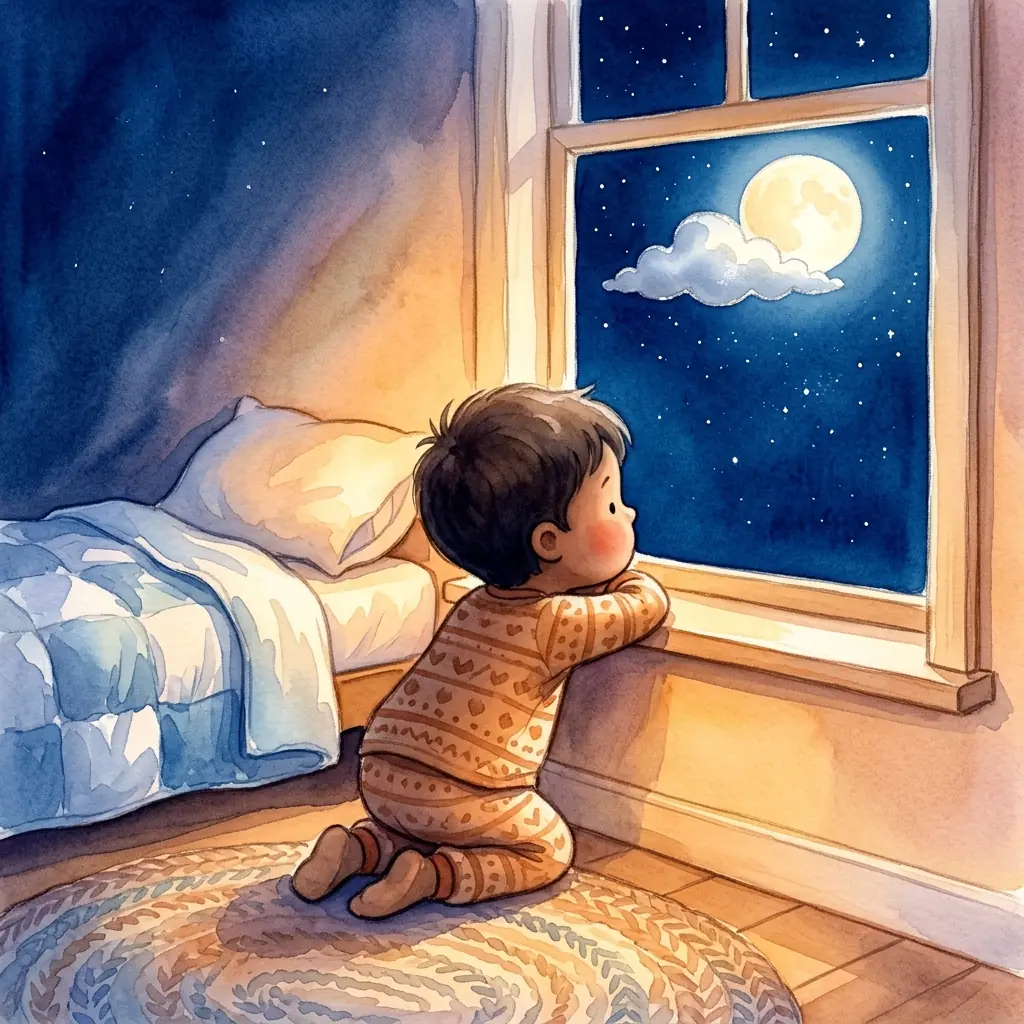 Ages 3-4
The Little Cloud’s Pillow
Sam notices a tiny cloud drifting past his window, wishing it could be soft enough to be a pillow. A gentle, moonlit four-minute tale.

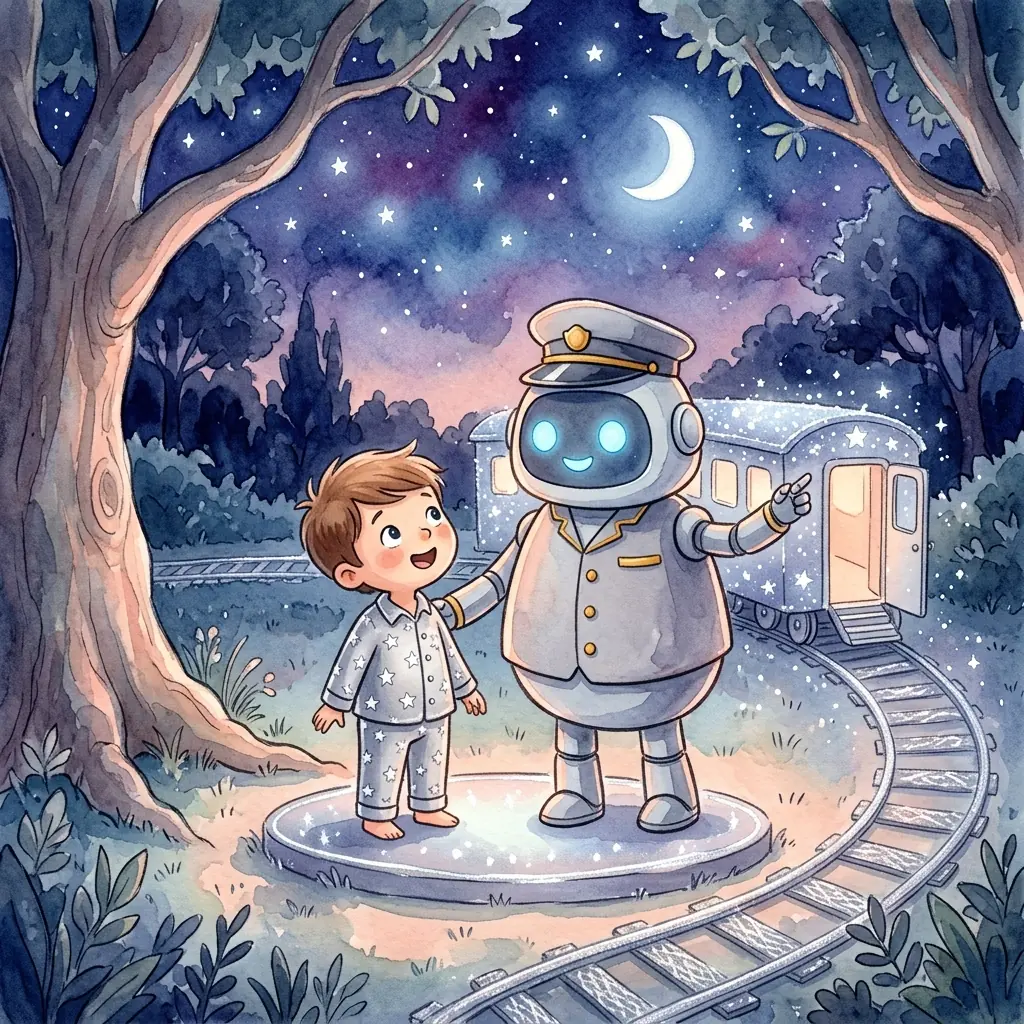 Ages 3-4
Sam’s Midnight Star Train
A soft toot wakes Sam at midnight, and a glowing little train carries him on a slow, gentle journey through the stars.
More stories, each with the full text, are in our story library. On a tired night, our short bedtime stories take about five minutes.
A Sleeping Story Made for Your Child
Library stories are the same for every child. With Bedtime Stories, you describe the story you want (a slow river, a quiet train, the clouds over your own street), and your child becomes the one floating, riding and counting stars.
- Your child is the hero. Words are pitched for one of four age levels from 3 to 12.
- A voice your child picks. Choose from 100+ voices and keep the one your child likes, or record your own voice for free so the story sounds like you.
- Designed with child safety in mind. Stories are written for gentle endings at your child's age level, and you can read the full text before your child hears it.
- No subscription. Stories start at $2 each, credits never expire, and you can download the audio as an MP3.
Make the story in the afternoon, then press play at bedtime and put the phone away.
Keep Reading
For stories matched to your child's age, see our guides to bedtime stories for toddlers, bedtime stories for preschoolers and bedtime stories for 5-8 year olds, or the age-by-age bedtime story guide. For the science of why stories matter at all, read why bedtime stories matter.
Common Questions
What is a sleeping story?
A sleeping story is a bedtime story written to help a child fall asleep rather than to excite them. It has little or no conflict, a slow pace, gentle sensory detail (warm sand, soft rain, a quiet train) and an ending that winds down into stillness. Many include a small relaxation exercise, such as squeezing and releasing the hands or taking slow breaths.
How long should a sleeping story be?
Five to fifteen minutes suits most children. Toddlers and preschoolers often settle with five minutes, while older children may want a longer, slower journey. The best sign of a good length is a child who is drowsy before the end. If your child falls asleep before the end, the story was long enough.
Is white noise or a story better for falling asleep?
They do different jobs. White noise masks household sounds and can help a baby settle, while a calm story gives an older child something gentle to follow instead of their own worries. Many families use both: a story first, then soft background sound at a low volume, with the speaker across the room rather than next to the bed.
At what age do sleeping stories work?
Once a child can follow a simple story, usually from about age two or three, a calm story can become part of bedtime. For toddlers keep it very short and repetitive. Children up to about twelve still benefit, but older children prefer stories that do not feel babyish, such as a slow walk through a quiet place or a long train journey at night.
Can I make up my own sleeping story?
Yes. Pick a peaceful place, give your child a slow task (counting stars, floating down a river, watching clouds), describe what they feel, hear and smell, and let everything get quieter and slower towards the end. Speak more slowly than usual and leave pauses.
Bedtime Routines and Sleep
Relaxation Techniques
White Noise and Sound
- White Noise and Sleep Induction (Archives of Disease in Childhood, 1990)
- Infant Sleep Machines and Hazardous Sound Pressure Levels (Pediatrics, 2014)
- Impact of White Noise on Sleep Quality Across Age Groups and in Critically Ill/Non-Critically Ill Patients: A Systematic Review and Meta-Analysis of Randomized Controlled Trials (Sleep Medicine, 2025;136:106869)